
Begin with the right professional frame
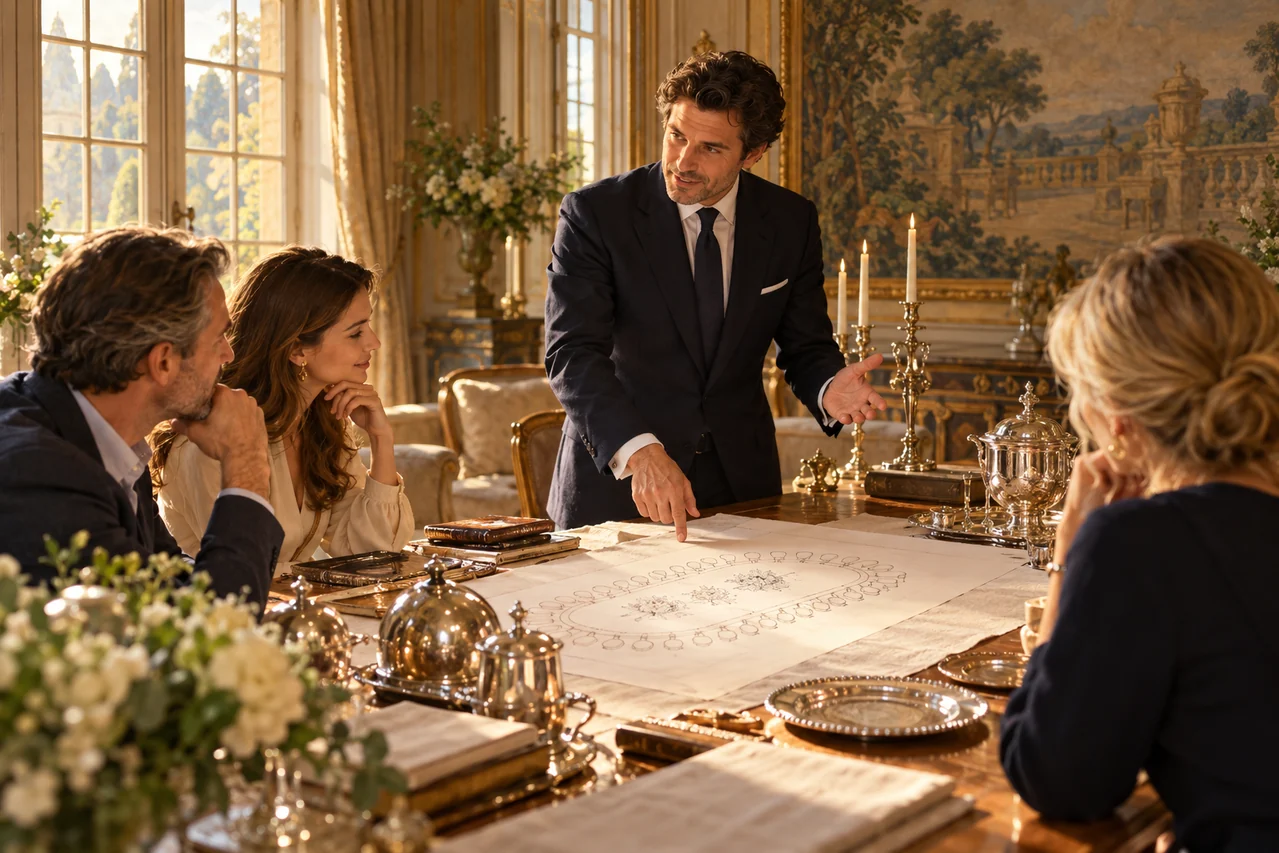
Vatel is often described as a chef, but that modern shorthand narrows his role. His work belonged to the organization of service and the running of major aristocratic receptions. Maître d'hôtel comes closer to the historical setting, provided it too is explained through seventeenth-century household structures. Travelers can think of him as someone coordinating a system, not merely creating dishes. The distinction matters because it opens a richer story of people, supplies, spaces and responsibilities behind an apparently effortless occasion.
Fouquet supplied one important setting
Vatel worked in the environment of Nicolas Fouquet, Louis XIV's powerful superintendent of finances. The household's hospitality belonged to a world in which art, architecture, gardens and reception could display magnificence. Vaux-le-Vicomte makes that relationship especially tangible. A visit or narrative connected with the domain can therefore examine several forms of organization together. Food was one component of a wider effect, and the person overseeing service helped translate aristocratic ambition into the practical conditions through which guests experienced it.
The famous celebration was not a complete explanation
The reception for Louis XIV at Vaux-le-Vicomte in 1661 became closely associated with Fouquet's fall. It is tempting to tell a simple story in which one dazzling party provoked royal jealousy and directly caused his arrest. The political and financial circumstances were more substantial than that anecdote allows. Keeping those causes visible protects the Vatel narrative from becoming a fable about excessive luxury. The festivities mattered as representation, but they should not be treated as an adequate explanation for the whole political outcome.
Condé opened a later chapter
Vatel subsequently served the prince of Condé, placing his organizational expertise in another major household. This transition helps establish a chronology that separates Fouquet and Vaux from Condé and Chantilly. The different settings for a Vatel story are useful only when those distinctions remain clear. The change also indicates how valued such expertise could be. A prince depended on people whose competence and discretion supported a public reputation, with hospitality exposing the household's capabilities before consequential guests.
Uncertainty was built into the work
Food supplies relied on seasons, routes and suppliers without modern refrigeration or instant communication. Organizers could not remove those uncertainties by wishing them away. Coordination therefore involved anticipating needs and managing the possibility of failure. How a grand dinner worked shows why an apparently small delay could have wider effects. Travelers can connect with that practical problem while remembering that the tools, social hierarchy and working conditions were markedly different from those of a contemporary restaurant or hotel.
The spectacular depended on invisible labor
Guests saw abundance and ceremonial order, while much of the decision-making remained out of view. Vatel stands at the point where those two worlds meet. His responsibilities reveal cooks, suppliers, servants and other people usually eclipsed by the host's name. This perspective is particularly useful for guests interested in hospitality, because it changes what counts as the historical achievement. A successful reception was not just a prince's expenditure or an artist's decoration; it depended on many forms of skilled and organized labor.
The final tragedy needs a careful account
Vatel died by suicide at Chantilly in 1671. Madame de Sévigné's correspondence reports the event in relation to the pressure of the royal reception and worries about supplies. Later retellings condensed it into a story about fish arriving too late. The source and its later legend should be distinguished. His death must not become an admirable demonstration of perfect service, and he should not be credited with inventing Chantilly cream. Neither myth is needed to explain why his life is historically significant.
Recover a career beyond the last day
An Encounter with Vatel can explore the functioning of aristocratic households before considering the event that dominates his fame. Elyrea's character-led dinner gives travelers a concrete setting for questions about coordination, hierarchy and the meaning of receiving. For advisors, the biographical angle offers more than a famous anecdote: it brings a working historical person into view. The memory can then include what Vatel organized and the society that depended on it, rather than treating his death as the inevitable conclusion of a picturesque gastronomic legend.
FOR YOUR GUEST ITINERARIES
For guests interested in hospitality or the Grand Siècle, contact Elyrea about using a Vatel Encounter to explore the people behind aristocratic spectacle.
Discuss your itinerary