
Count beyond the principal table
A royal reception involved more than one distinguished guest and a few companions. The host had to account for the wider entourage and the people supporting it. Numbers shaped quantities, staffing and the use of spaces. For visitors, this is an accessible way into the practical complexity of a great household. An apparently elegant meal rested on decisions about how many people needed to be accommodated and how different ranks and responsibilities would affect the arrangements around them.
Supplies imposed real limits
Seasonality, transport and limited preservation shaped what could reach the table in usable condition. The organizer needed enough food without the flexibility supplied by modern systems. A delay could not always be corrected quickly, and the availability of particular products depended on more than the host's purchasing power. These constraints help explain why planning mattered. Travelers should see abundance as an achieved effect rather than assume great wealth made the material difficulties of seventeenth-century hospitality disappear.
Service did not resemble a modern tasting menu
In forms of service associated with the period, several dishes could appear simultaneously within successive services. The display and arrangement mattered alongside what each person consumed. This differs from the contemporary expectation that every guest receives an identical individually plated course at the same moment. What aristocratic tables could contain adds the food context, but service deserves its own explanation. Guests then understand that the architecture of the meal was historical, not simply a modern sequence using older-looking recipes.
The table communicated through objects
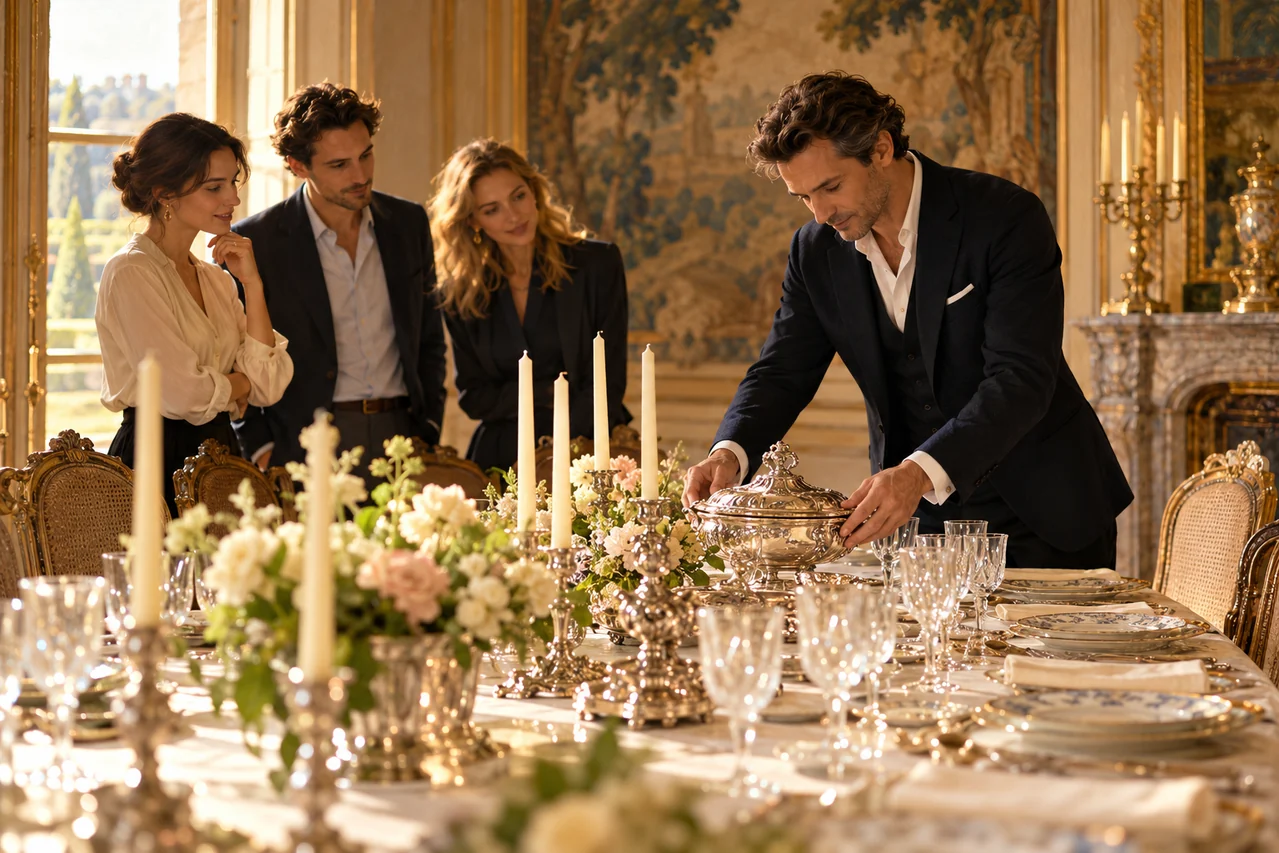
Linen, vessels, arrangement and presentation helped convey the household's status. A dinner could therefore operate as a visible social language. Those who understood the conventions could read rank and magnificence through details that present-day visitors might initially consider decorative. Cultural interpretation makes those details useful evidence. The question is not how much an object cost in contemporary terms, but what the assembled table demonstrated about access to resources, command of etiquette and the host's intended relationship with the guests.
Buildings shaped the work behind the meal
The distance between kitchens and dining spaces affected movement, timing and the condition of food. A great residence did not necessarily make every service task easy. Personnel had to negotiate the building while coordinating the requirements of a large gathering. This material dimension grounds an otherwise abstract story of luxury. It allows travelers to think about warmth, routes and waiting, showing how architecture and food culture intersected through daily work rather than only through the design of grand ceremonial rooms.
A hierarchy of workers made it possible
Cooks were important, but they were not the only contributors. Different household roles supported preparation, movement, service and the broader reception. Vatel's organizing responsibilities connected those functions. His historical profession offers a way to restore the people behind the host's prestige. The story should not impose the structure of a current restaurant brigade onto every older household. It should explain the historical relationships while giving labor an appropriate place in the account of what guests experienced.
Religious calendars affected the menu
Days on which certain meats were excluded could increase the importance of fish and other choices. The calendar therefore shaped procurement as well as diet. This context helps explain why a particular delivery might carry exceptional significance in the account of Chantilly. It also demonstrates that food history extends beyond taste: religious practice, social expectation and supply interacted. No fixed menu should be invented for every royal reception, because actual circumstances and the date of an occasion could change what was required.
Use the dinner to examine coordination
A theatrical Vatel can introduce a practical problem about quantities, timing or uncertainty, inviting guests to consider the work behind smooth service. The scene is dramaturgy informed by historical themes, not a recovered transcript of an actual banquet. Elyrea's Encounter uses the shared experience of being at table to make an unfamiliar system understandable. For advisors, this angle particularly suits hospitality professionals and curious families, with cultural depth arising from the organization of the occasion rather than only the ingredients on a plate.
FOR YOUR GUEST ITINERARIES
Planning a cultural experience for guests interested in gastronomy or hospitality? Ask Elyrea how a Vatel Encounter can explore the organization behind a grand dinner.
Discuss your itinerary