
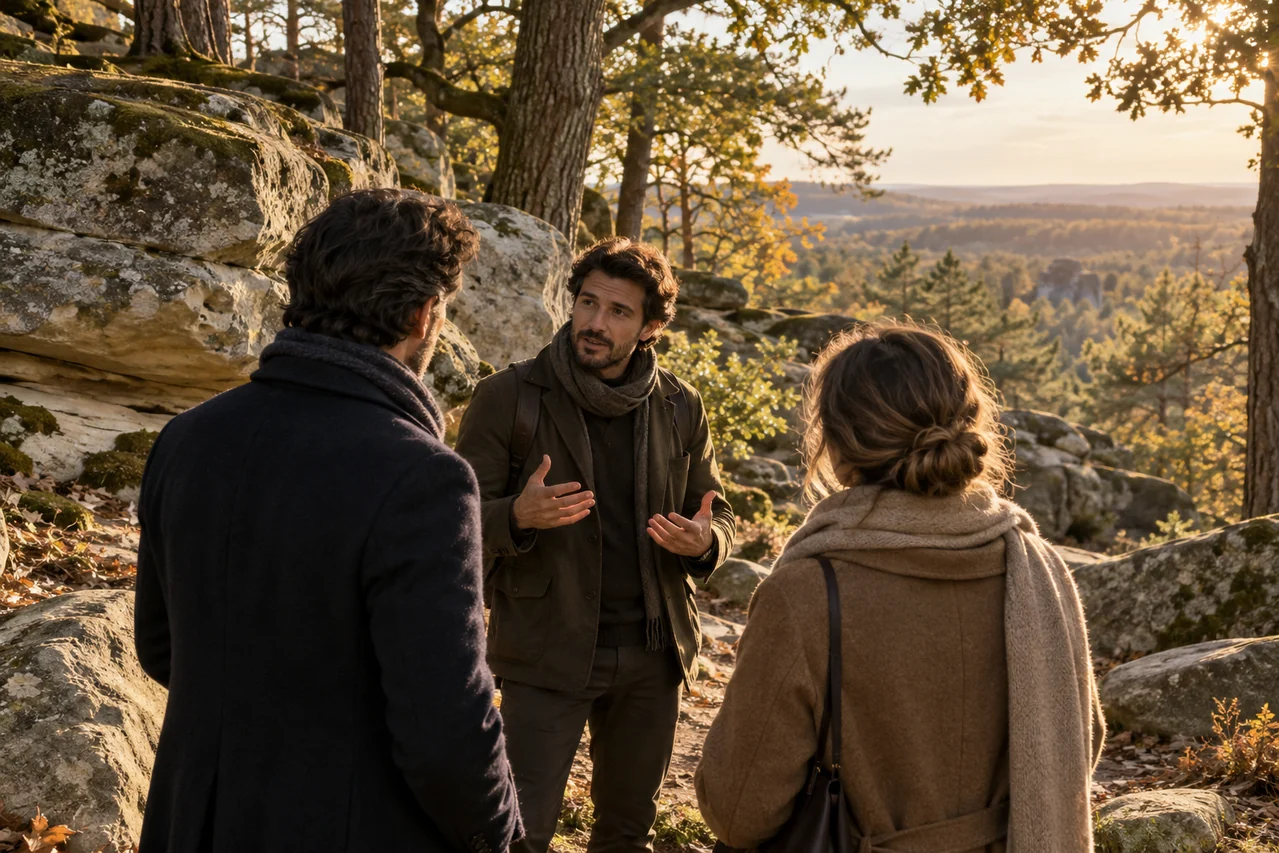
A guided visit can establish the historical framework
A skilled guide can explain the forest's uses, its connection with the château and the changes that made it a landscape destination. This structure is valuable for travelers who want clear chronology and contextual knowledge. A walk may also emphasize nature, terrain or the traces of human management, depending on its purpose. The term classic should not imply unimaginative or superficial. Its strength lies in organizing information and observation so that participants understand what they are seeing and how it fits a broader history.
An Encounter adds a character's perspective
The Grand Veneur gives Fontainebleau a narrative voice associated with the legendary royal hunt. Rather than receiving every explanation from outside the story, participants enter a relationship with an embodied figure and the real setting. This changes the mode of attention: a sound or path can acquire significance within an unfolding conversation. The difference is not simply a costume added to a lecture. The value depends on the connection between character, place, cultural material and interaction, all serving the guest's understanding of the forest.
Keep the legendary status explicit
The Grand Veneur belongs to folklore, whose versions change across tellers and periods. An Encounter does not provide archival testimony from a historical huntsman whose life is fully documented. This distinction protects the cultural strength of the experience. Travelers can enjoy the narrative without confusing emotional conviction with proof. The Grand Veneur's place in Fontainebleau folklore is therefore a useful starting point, especially for guests who expect historical interpretation and should know which aspects are tradition and which are grounded in documented context.
Interaction can turn uncertainty into a useful question
A legend often leaves things unresolved. Participants can compare possibilities, ask why a story survived or notice how their own interpretation changes as they walk. Such uncertainty is not a defect requiring a fabricated answer. It belongs to the cultural subject. An advisor choosing this format should value that exploratory quality. The aim is neither a supernatural demonstration nor an exercise in dismissing belief. It is a way to discover how people construct meaning around a landscape and how a visitor can examine that process personally.
Returning travelers may need a different viewpoint
Guests who already know Fontainebleau's palace may prefer the forest as an independent chapter. They do not necessarily need additional rooms or a more compressed version of the first visit. A Grand Veneur Encounter changes the perspective toward hunting, folklore and the surrounding territory. A guided walk can also provide renewal if it focuses on landscape or artistic history. The choice should follow what was absent from the earlier experience. Familiarity with a destination is an opportunity to deepen interpretation rather than repeat the introductory essentials.
Families benefit when mystery supports real observation
A legendary character can hold a shared question across different ages, while the forest offers sounds and shapes to investigate. This works best when participants remain attentive to the actual place and when walking demands suit the group. A family cultural forest adventure can include thinking about evidence and imagination without making the experience academically heavy. It should also leave quiet intervals. Continuous spectacle is unnecessary; the landscape and each participant's observations already provide rich material for a conversation among generations.
Combine formats when their roles are complementary
A guided visit and an Encounter can belong to one day if they answer different needs. General history might establish royal and geographical context before the legendary narrative begins; Barbizon might then add an artistic perspective on the same territory. Repeating identical material through several formats is less useful than giving each a defined contribution. The guest should experience a progression, not a succession of introductions. Practical pacing matters too: interpretive depth improves when there is enough time for observation, a meal and discussion between concentrated chapters.
Choose according to the desired memory
What should guests be able to explain after leaving Fontainebleau? A clear historical overview, a sharper way of seeing the forest or a memorable conversation with its legendary inhabitant suggest different emphases. None requires promises of secret access or complete solitude. Elyrea's Grand Veneur Encounter offers a character rooted in the forest's cultural imagination, while the itinerary around it can supply context and balance. The strongest choice is the one that fits the travelers and gives the destination meaning beyond a collection of sights.
FOR YOUR GUEST ITINERARIES
Comparing Fontainebleau options for your guests? Contact Elyrea to discuss the Grand Veneur Encounter and how it can complement a guided visit or wider cultural excursion.
Discuss your itinerary