
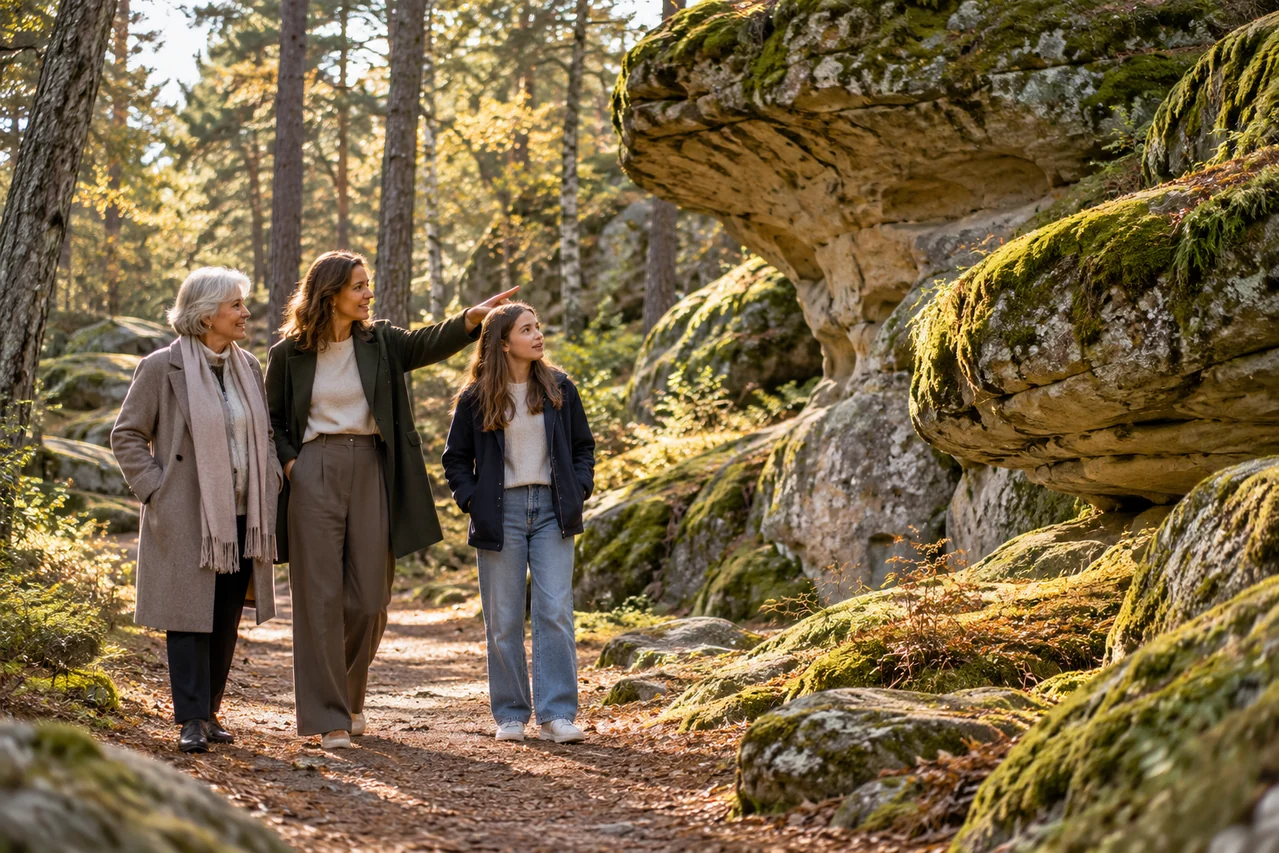
Give the walk a question everyone can share
A question such as why people tell stories about a mysterious huntsman provides a useful starting point. Younger children can follow the mystery, while older participants ask what distinguishes a legend from a historical fact. The family does not need to agree immediately on an answer. A shared inquiry is often more engaging than separate explanations aimed at each age group. Fontainebleau's landscape then becomes part of the investigation rather than a stretch of ground crossed between educational stops.
Invite observation before supplying an interpretation
A child may notice a face in a rock or hear a noise that adults have ignored. Asking what they see or hear gives them a role in discovering the place. Information can follow as a response to that observation, rather than arrive first as a lecture. The approach also reminds adults that looking is not passive. Different people can interpret the same shape differently, providing an immediate explanation of how names, stories and legendary figures become attached to natural features over time.
Separate fact, tradition and performance without removing wonder
The Grand Veneur belongs to folklore. Royal hunting and the historical use of the forest belong to a different evidential category, while an Elyrea Encounter gives the legend an embodied narrative form. Children can understand these distinctions when they are expressed plainly. A fascinating story does not have to be a documented event to matter. Exploring Fontainebleau's legends can therefore strengthen curiosity and critical thinking at the same time, leaving imagination its place while avoiding the confusion of theatrical action with historical proof.
Listen to the forest as well as looking at it
A brief pause to identify wind, birds, leaves and distant sounds changes the pace of the walk. Participants can compare what they thought they heard with what they can actually locate. That small exercise explains why unfamiliar sounds become material for stories, especially when visibility is limited. It needs neither theatrical machinery nor a manufactured fright. Listening also creates an interval in which the environment takes the lead, so the family experience does not depend on constant commentary or continuous performance.
Make royal hunting a question about society
For older children and teenagers, the hunt introduces ideas of privilege, hierarchy and control of territory. Who had access to particular activities, and what did they mean at court? These questions are more useful than memorizing many sovereigns in rapid succession. The forest and château can support one another: a palace visit identifies the visible world of power, while a walk reveals an outdoor setting connected with that world. The appropriate order depends on the family's attention, interests and energy.
Try a painter's way of framing a view
The artistic history of nearby Barbizon offers another accessible activity: choose a scene and ask what makes it worth representing. Moving a short distance can change the relationship between a tree, a rock and the light. A photograph or an imagined frame can make that choice concrete without requiring drawing lessons or art vocabulary. Barbizon's painters and their landscape then become relevant through an experience the family has already shared, rather than a list of names delivered while children wait to move again.
Choose a manageable route and allow quiet intervals
Age, mobility, weather and familiarity with outdoor walking should shape the excursion. A shorter route with good opportunities for attention often works better than a long circuit whose final stage becomes tiring. Suitable footwear and realistic terrain expectations deserve advance consideration. There should also be unhurried moments when participants simply notice the place. Cultural value does not increase with the number of facts spoken per minute, and family enjoyment should not depend on every child sustaining the same level of concentration throughout.
Build a memory that everyone can retell differently
Afterwards, one family member may remember a strange rock, another the legendary hunt and another a discussion about protecting landscapes. These memories can belong to the same coherent day. The Grand Veneur Encounter supplies a narrative focus, while walking and observation give participants their own material. The outcome is not a forced belief in a ghost or a uniform lesson. It is a shared story about discovering how people perceive a forest, with enough substance for conversations to continue after returning to Paris.
FOR YOUR GUEST ITINERARIES
Designing a multigenerational stay near Paris? Contact Elyrea to discuss a Grand Veneur Encounter and a Fontainebleau itinerary suited to your guests' ages, interests and walking preferences.
Discuss your itinerary