
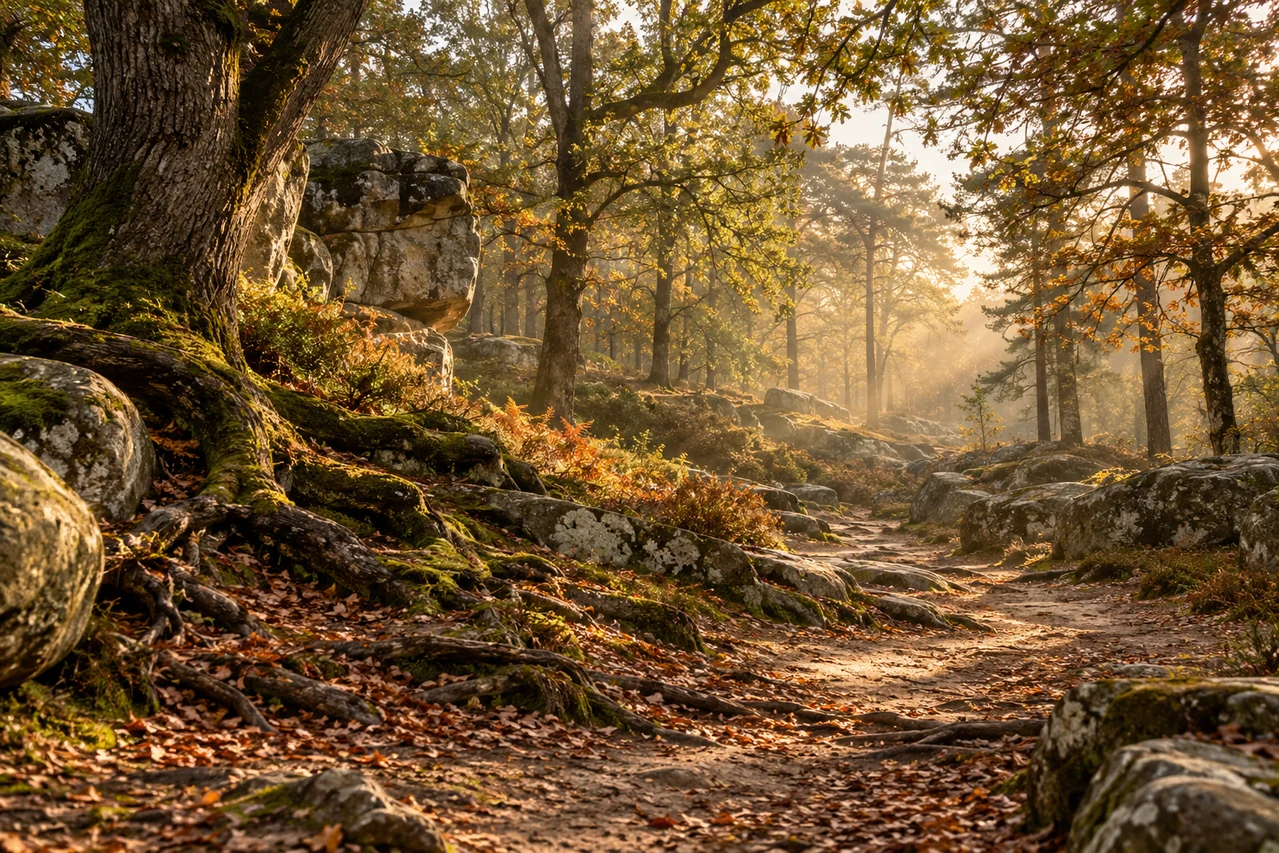
A landscape where familiar directions can dissolve
A city provides street names, addresses and distinctive façades. In woodland, repeated trunks and branching paths can make orientation less obvious, especially to an unfamiliar traveler. Before contemporary navigation tools, losing one's way also carried practical danger. The resulting uncertainty needed no supernatural cause, but it supplied powerful material for supernatural stories. Fontainebleau's legends become easier to understand when the visitor recognizes this ordinary human experience: not knowing precisely where one is, or what lies just beyond the next turn.
Sounds invite interpretations before facts arrive
A branch moves, an animal passes through leaves or a distant noise travels across the trees. The listener receives an impression before identifying its source. In different periods, people brought different knowledge and beliefs to that gap. A sound that a modern visitor explains casually might once have suggested a warning or unseen presence. The point is not to caricature earlier societies as credulous. It is to recognize how perception and cultural expectations work together when the environment withholds an immediate explanation.
Sandstone gives the forest a distinctive vocabulary
Fontainebleau's sandstone formations create more than attractive scenery. Irregular rocks invite comparisons with animals, faces or structures, and those comparisons can become names and stories. Once a formation receives a suggestive name, visitors begin searching for the resemblance themselves. Language changes the act of looking. This process helps explain how natural features acquire cultural personalities over time. An account of legends can therefore begin with geology and observation before it moves toward imagined inhabitants or dramatic events.
Royal hunting adds power to the imagination
The forest's association with sovereigns gives an apparition a particular dramatic weight. A tale about a warning to a king brings the unknown into contact with visible authority. Hunting contributes its own sounds, movement and social hierarchy, making the legendary Grand Veneur an especially coherent figure. The story draws force from this setting without becoming a historical report. Understanding the Grand Veneur means examining why the hunt and the monarch form such an effective narrative partnership.
Working lives leave a different kind of memory
Forestry and quarrying remind travelers that this was also a productive landscape. People knew its materials, routes and difficulties through their labor. Those histories should sit alongside courtly stories, not disappear beneath them. An apparently timeless clearing or exposed rock may belong to a landscape shaped by human uses. Recognizing that possibility changes the visitor's questions. Instead of assuming every unusual feature has a fantastic explanation, one begins considering economic activity, management and the changing relationship between local communities and the forest.
Artists teach later visitors another way to see
Nineteenth-century painters associated with Barbizon helped establish Fontainebleau as a landscape worth studying. Attention moved toward trees, light, rural work and the choices involved in representing nature. This artistic regard offered a different imaginative framework from the royal hunt. It also fed arguments about preserving valued scenery. Barbizon's relationship with the forest demonstrates how a place can become culturally important through repeated observation, rather than through one spectacular event or one supposedly supernatural encounter.
Paths and leisure continue to remake the forest
As walking and landscape appreciation developed, routes and guides helped urban visitors identify places worth noticing. That organization created another layer of meaning: the forest as a destination for exploration and contemplation. A mapped landscape can still encourage imagination, even when finding one's way becomes easier. Knowledge does not automatically eliminate mystery. It can instead make a visitor more attentive to the difference between a named viewpoint, an inherited story and a detail discovered personally during the walk.
Use legends to deepen attention to the real place
Fontainebleau does not need invented crimes or fabricated archival claims to hold an audience. Its existing traditions can introduce discussions about hunting, social privilege, artistic observation and conservation. The Grand Veneur Encounter follows that potential when it makes the surrounding forest more legible rather than replacing it with a generic fantasy. For travelers, the lasting gain is a richer habit of looking. For advisors, the opportunity is an excursion whose narrative emerges from the destination itself and can be matched to guests' interests.
FOR YOUR GUEST ITINERARIES
Creating a nature and culture itinerary beyond Paris? Ask Elyrea how Fontainebleau's folklore can connect your guests' interests with a Grand Veneur Encounter.
Discuss your itinerary