
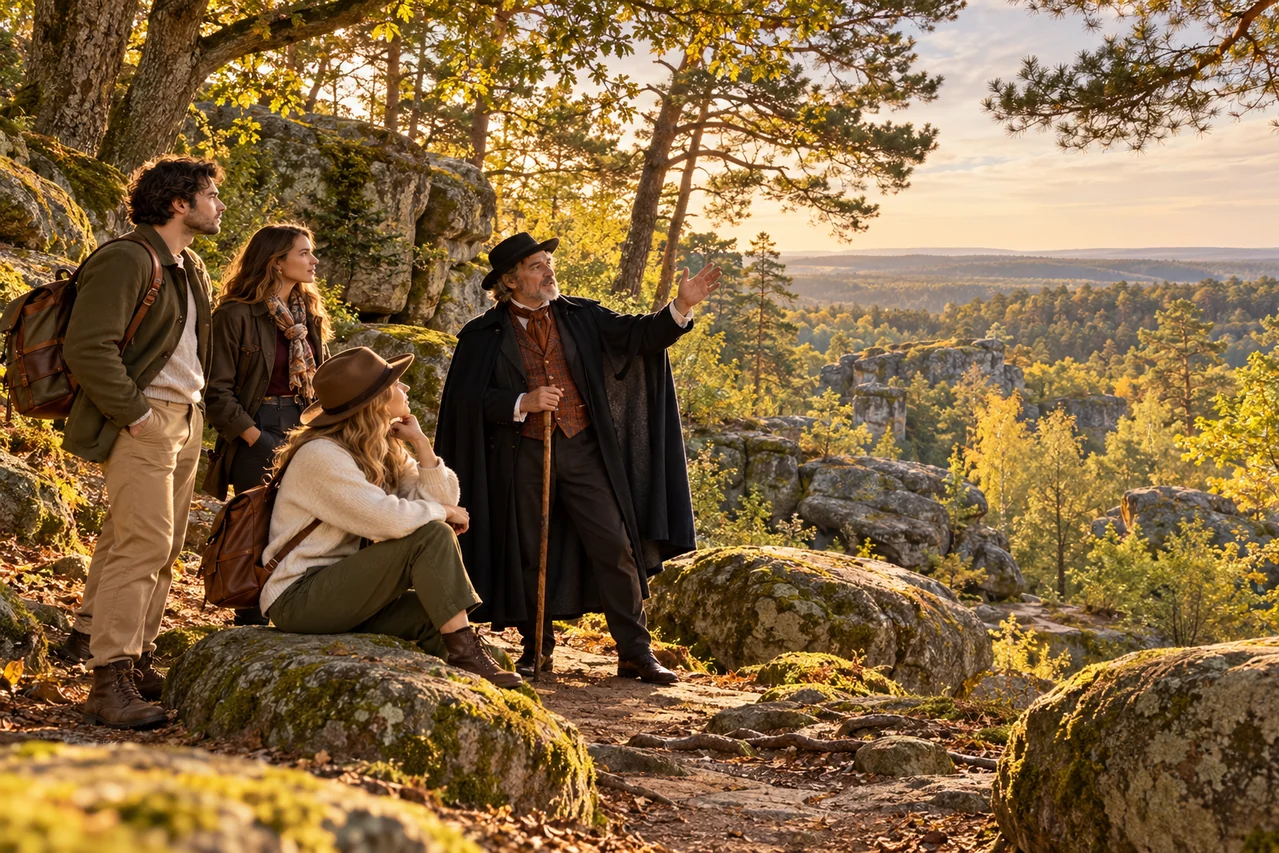
Choose the next chapter of the trip
Before comparing destinations, identify what the Paris stay has begun to explore. A museum visit may lead naturally toward an artist's landscape, while a discussion of monarchy can open questions about court life at Versailles. The excursion then extends a theme the traveler already cares about. This is more useful than choosing solely by fame or proximity. Consider the practical journey too: the value of the subject must justify the time, movement and attention the day will require. The theme can also clarify why an attractive destination should be omitted. If the excursion repeats the same kind of attention without deepening the question, a focused Paris chapter may serve the traveler better. Conversely, a change of place can be worthwhile when it adds a landscape or institutional setting that the city cannot provide. Present the relationship in concrete terms rather than a vague promise of discovering another side of France. Consider what guests already know and how much time they want to devote to the subject. The best recommendation joins interest with realistic conditions, so the transfer is understood as part of a meaningful journey rather than a cost in energy accepted only because a place is famous.
Versailles for the world behind royal display
Versailles can offer much more than recognition of the Hall of Mirrors. Through Marie-Antoinette, a visitor can explore etiquette, visibility and the difficulty of creating private life within a public institution. The Petit Trianon and Hameau contribute different perspectives from the palace's ceremonial spaces. A character-led approach to Versailles is especially relevant when the guest wants a human thread. For returning visitors, select a new question rather than reproducing the entire standard route. Explain the functions of spaces instead of describing all of them in the same language of royal splendor. A ceremonial room, a retreat and a cultivated setting allow different questions about public role and personal life. Their contrasts give the itinerary more substance than an undifferentiated sequence of decorative highlights. A character-led narrative should remain connected with these relationships, while dramatized dialogue stays distinct from historical evidence. The queen's biography can organize attention without replacing the wider institution. Advisors can build a focused day around that distinction and confirm actual visits separately, avoiding the impression that every place discussed in an article automatically belongs to the selected performance or access arrangement.
Giverny for the relationship between garden and painting
Monet's Giverny connects an artist's environment with his sustained investigation of what he saw. The garden is not simply a backdrop resembling a familiar painting; it was shaped into a place of work and observation. A visitor who has looked at Monet's art in Paris arrives with a useful frame of reference. The excursion can then consider the house, garden and changing effects of light as related parts of a life. It suits guests drawn to painting, landscape and the pleasure of sustained looking. The guest's observations from paintings can guide the excursion without determining every response in advance. A familiar motif may look different in an actual garden because pictorial space and a lived landscape serve different purposes. Let the visitor notice that distance rather than treat resemblance as the only valuable result. The house can add a daily-life perspective, while the garden encourages slower looking. Practical plans should account for the chosen visit and the group's interests without claiming special access that has not been arranged. Giving Giverny its own clear role allows it to become more than a recognizable destination, connecting the artist's sustained work with the environment he helped shape and repeatedly reconsidered.
Auvers for Van Gogh's final period of creation
Van Gogh spent the final weeks of his life in Auvers-sur-Oise in 1890. Places associated with his paintings, the Auberge Ravoux and the graves of Vincent and Theo can create a powerful day, but the work should remain central. Avoid reducing the visit to illness or death, and distinguish the traditional account of his death from debated details. Exploring Van Gogh's last days in Auvers should offer both artistic attention and respectful biographical context, with time for the traveler to absorb each. A sensitive biographical visit should leave the traveler free to respond without making death the required climax. Paintings and their subjects deserve attention alongside commemorative places. Distinguish what a surviving setting can show from what would need documentary explanation, and make uncertainty clear where it matters. Keep the distinction between an established setting and an uncertain account of events clear, giving guests room to reflect without making tragedy the only meaning of the visit. Nor does the artist's suffering explain the entire work. An advisor can alternate artistic looking and personal context, allowing both to be absorbed. The excursion then remains powerful because it addresses a whole creative person and a particular period, rather than relying on a tragic image that obscures labor, relationships and pictorial choices.
Fontainebleau for forest, imagination and artistic history
The forest introduces a different cultural landscape from the famous château. Royal hunting, folklore, the painters of Barbizon and the protection of valued landscapes can become connected themes. Legends such as the Grand Veneur should be identified as legends, allowing their imaginative appeal without presenting them as documented events. A forest excursion may suit families or guests who want movement and nature within a cultural journey. Its distinct value comes from reading a landscape through several human relationships with it. Forest history also asks travelers to consider several ways of valuing a place. A royal hunting environment, a painter's subject and a protected landscape do not mean the same thing, even when they overlap geographically. Folklore offers another relationship, revealing imagination rather than proving an event. These differences can make the excursion especially accessible to a mixed-interest group, because nature, art and narrative provide several entry points. Establish the actual walking conditions with the team and allow time for observation instead of assuming outdoor culture requires less attention. The setting's value lies in how the narrative connects human uses and meanings with the landscape, not simply in the novelty of leaving the city's buildings behind.
Rouen for Jeanne d'Arc and the history of memory
Rouen offers a setting for exploring Jeanne d'Arc's trial, rehabilitation and later place in national memory. The excursion can be shaped around legal and political questions, the fifteenth-century context or the changing interpretation of her story. Establish which interests matter to the traveler before selecting the emphasis. The destination should help explain why the events and their memory belong there. A focused day can be more satisfying than trying to add every architectural and historical subject the city offers. The history of memory deserves its own frame. A person investigated through a fifteenth-century context is not identical to the national figure later audiences created. Rouen can make that distinction tangible through a focused inquiry into trial, rehabilitation and subsequent interpretation. Ask whether the guest wants events, legal questions or the transmission of an image to lead the day. Then let the other material support that choice rather than compete for equal time. The city remains more than an illustration, but the program need not become exhaustive to be culturally substantial. Selectivity allows guests to understand the relationship between place and question, and leaves room to consider what changed when later generations retold the story.
Treat Normandy as a distinct commitment
Omaha Beach belongs within a wider Normandy itinerary that deserves its own careful planning. It should not be inserted casually as one more cultural outing among nearby Paris destinations. Terrain, military context, remembrance and personal family connections may all influence the experience. Allow appropriate time and explain the role of the beach within the broader D-Day story. Planning a respectful Omaha Beach visit helps establish why this journey requires a different rhythm from an artistic or royal excursion. Remember that a site of memory has a different social purpose from an attraction whose main aim is entertainment. Explain terrain and chronology with care, recognize the people affected and avoid sensational staging. A performed narrative can support engagement without inventing a documented life for Charles or turning the audience's emotion into evidence. Some travelers may have a personal connection; others may be learning the wider history for the first time. Both need clear context and room for reflection. Advisors should present the travel commitment honestly and coordinate the rest of the day around it, rather than append demanding activities that leave no mental space for the subject just encountered.
Balance discovery with the guest's energy
A good excursion provides contrast without breaking the journey's coherence. Avoid stacking unfamiliar destinations simply because each is attractive. Consider whether the guest wants to walk, look closely, discuss history or reflect quietly, and leave space for lunch and the return journey. The same destination can serve a specialist, a family or a returning visitor differently. The advisor's recommendation should explain what the day adds to Paris and why that contribution is worth traveling for. The final choice should be explainable through what it contributes to this guest. A landscape may offer sustained looking, a palace institutional context, and a trial-related city a question about judgment and memory. Those are distinct outcomes, not interchangeable versions of a cultural day out. Plan transitions and pauses so the traveler retains energy for the chosen form of attention. A longer journey is justified by a meaningful chapter, but no thematic argument removes practical limits. The advisor can preserve quality by reducing the number of destinations or giving a major excursion its own place in a longer stay. Coherence comes from relationships that guests can understand and experience, rather than from connecting every possible destination with an impressive itinerary title.
FOR YOUR GUEST ITINERARIES
Choosing the right cultural excursion for your guests? Our team can help connect an Elyrea Encounter with the wider Paris itinerary and their specific interests.
Discuss your itinerary