
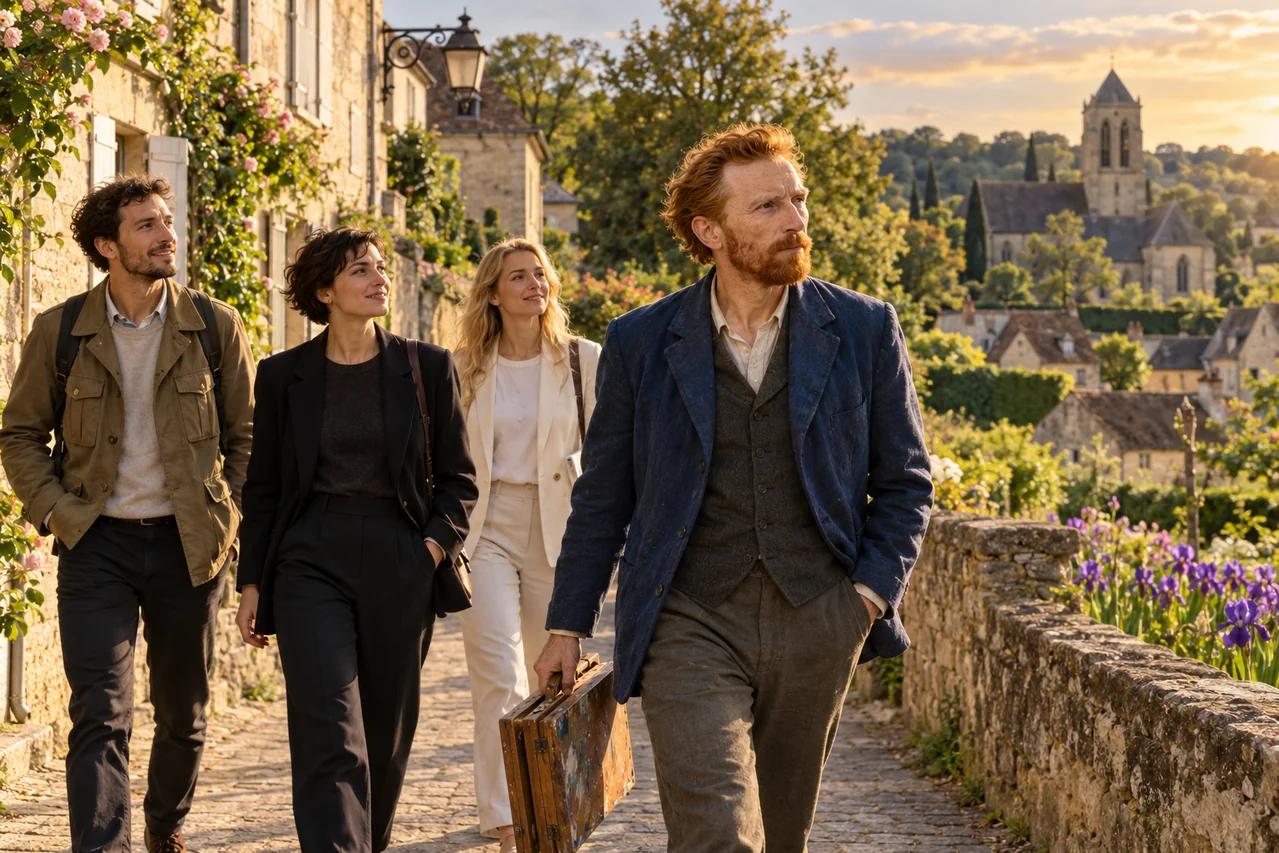
Saint-Rémy precedes the Auvers story
Van Gogh's arrival at Auvers followed his time at Saint-Rémy, and that transition supplies necessary context. Moving meant changing his living circumstances while continuing to work as a painter. The history should not be reduced to a clinical narrative, nor should his health be removed from the account. What matters is the combination of needs: a manageable environment, subjects for painting and access to support. Those practical concerns help make the choice of Auvers intelligible.
Paris offered proximity, but not the desired setting
Being near Theo and the capital did not mean Vincent needed to live in central Paris. A rural location could offer subjects and a different daily environment while retaining a connection with the city. This balance distinguishes Auvers from an artistic retreat completely cut off from social and professional life. For visitors, the surrounding landscape is therefore more than scenery. It is part of the conditions Vincent hoped would allow him to resume and sustain his work.
Theo's presence mattered alongside his own responsibilities
Theo was an essential source of support, but he also had professional and family commitments. Recognizing those circumstances prevents the relationship from becoming a simple arrangement in which one brother existed only to maintain the other. The move closer to Paris can be understood within that complicated bond. Vincent and Theo's relationship develops the story through support, dialogue and correspondence, showing why family proximity mattered without suggesting that it could remove every difficulty.
Pissarro and the connection with Gachet
Pissarro helped connect the discussion of Vincent's next circumstances with Doctor Paul Gachet. Gachet's interest in artists made him a particular kind of contact, not just a doctor selected without regard to Vincent's vocation. Including this connection reveals the role of artistic networks in the move. The destination was shaped partly by people who knew one another and understood something of the painter's needs, even if the resulting arrangement could not guarantee a settled future.
Gachet brought several roles into one relationship
Physician, collector and artist, Gachet could meet Vincent through interests that exceeded medical supervision. Their relationship nevertheless included ambiguity and doubt. It should not be described as an immediately perfect friendship or a certain solution to the artist's health. The resulting portraits demonstrate artistic engagement, while the letters and circumstances complicate an easy characterization. Gachet's place in the Auvers story examines that mixture of medicine, art and personal connection in more detail.
Auvers had already attracted painters
The village's connection with Daubigny and other artists helped establish it within an artistic landscape. Vincent did not enter an untouched setting; he came to a place where the relationship between rural life and painting already had a history. That context matters when comparing Auvers with other excursions from Paris. The interest is not solely that a famous man lived there briefly. The destination also shows how artists found subjects and contacts beyond the metropolitan center.
The work suggests a continuing project
Van Gogh's remarkable production at Auvers contradicts the assumption that the move was simply the final stage of an inevitable withdrawal. He painted landscapes, houses, gardens and portraits with sustained attention. Creative energy and vulnerability can coexist without one explaining the other mechanically. Visitors can consider the paintings as active investigations rather than signs awaiting interpretation through his death. The move introduced new subjects and relationships that deserve to be understood in their own right.
Read the choice before reading the ending
An Auvers Encounter can invite guests to imagine the destination as Vincent encountered it: a possible setting for continued work and life. The later events remain important but need not organize the entire experience retrospectively. Advisors can frame the day around why he came, what he found and how he painted. This gives the village a fuller meaning and restores a measure of possibility to a life too often narrated from its tragic conclusion backward.
FOR YOUR GUEST ITINERARIES
If your guests want to understand Van Gogh beyond familiar myths, Elyrea can help connect an Auvers Encounter with the circumstances and places that shaped his move.
Discuss your itinerary