
Begin with an artist's needs rather than a masterpiece list
Père Tanguy's perspective introduces supplies, support and the uncertainty of recognition. This establishes a human foundation before guests encounter works whose importance now seems undisputed. Exploring Montmartre through the color merchant shows how the neighborhood supported artistic life while welcoming successive generations. It is a useful first chapter because it asks how work becomes possible. The visitor can then approach museums with an interest in making and reception, not only recognition of images already seen in reproductions.
Make the Paris network intelligible
Studios, social spaces and suppliers connect art with the ordinary city. Renoir's scenes of leisure link Montmartre directly with an important Impressionist concern, while later painters extend its cultural history. Van Gogh and Picasso must remain distinct from the movement rather than be added to it for convenience. A clear chronology helps the itinerary move between influence and change. Paris becomes a setting where people exchanged ideas and sustained careers, not a timeless gathering of all the painters guests happen to admire.
Let a collection supply the next chapter
After the historical and social context, selected paintings can be seen with questions about subjects, light and reception. A knowledgeable guest may prefer to begin with the collection and use the Encounter to reconsider its familiar works afterward. The order is adaptable. What matters is the relationship between stages, so that each develops the inquiry rather than restarts a general introduction. A Paris itinerary for Impressionism enthusiasts offers ways to choose a focus and avoid museum fatigue.
Leaving the city changes the relationship with place
The move toward Giverny allows the narrative to shift from an urban network to an environment strongly associated with one painter. The pace and surroundings change as well. That transition deserves time rather than functioning only as a transfer to another attraction. An advisor can let the journey mark a new kind of artistic question: not how a community helps sustain work, but how an artist shapes and repeatedly observes a place that becomes a central subject.
Giverny belongs to Monet's later development
Monet settled in Giverny in 1883, after Impressionism already had a history. The village should therefore not be called the movement's birthplace. His house and gardens represent a chapter developed over time, with an environment shaped by the artist and then transformed through painting. Why Monet chose Giverny provides a biographical continuation. The date helps travelers understand a mature stage without implying the painter's work began or ended within the garden familiar from later images.
The garden is both made and observed
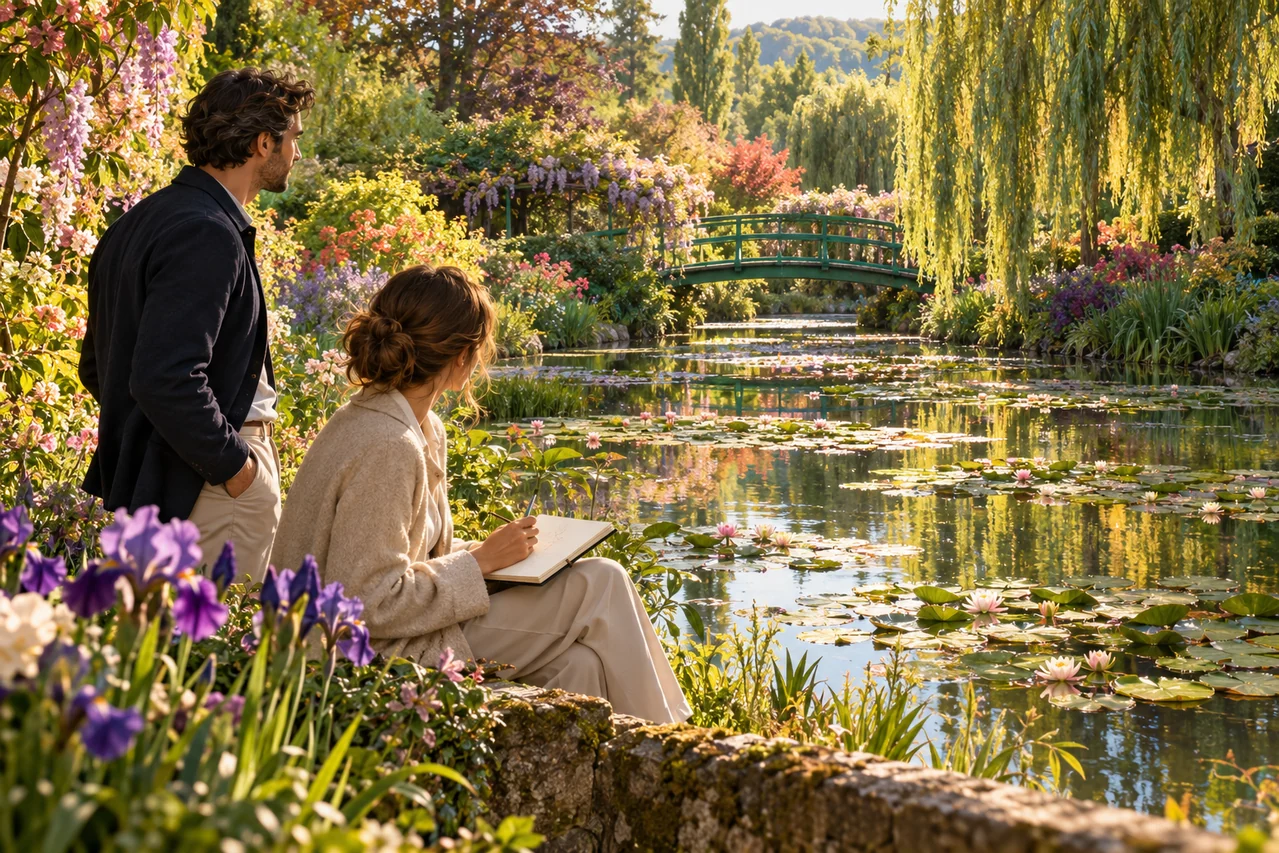
At Giverny, Monet did not simply find a ready-made subject. Cultivation and organization helped create an environment that then fed his painting. The water garden brings reflections, vegetation and changing conditions into a continuing visual investigation. Seeing the place and considering the Nymphéas invites comparison between a landscape and its representation. The itinerary can return to Parisian collections with that context, letting the actual garden and the paintings illuminate one another without assuming that a canvas is a straightforward copy of a view.
Auvers is a possible extension, with another purpose
A further chapter at Auvers-sur-Oise introduces Van Gogh's final weeks and a painting practice generally associated with Post-Impressionism. That adds development rather than simply more of the same movement. The sequence can follow artistic themes or practical logistics; there is no obligation to impose a perfect chronological order. Each place needs enough time to retain its identity. Advisors should resist presenting Paris, Giverny and Auvers as an easy collection of brief stops if that would undermine the guest's attention.
Let the journey show how recognition changes
The itinerary moves between work made under uncertain conditions and places now treated as cultural heritage. That contrast raises a substantial question about how taste and reputation develop. It does not prove that every innovation will eventually succeed. For families, American travelers and collectors, different levels of explanation can preserve the same underlying progression. The strongest result is a connected understanding of artists, works and places, with room for guests to discover their own memorable details along the way.
FOR YOUR GUEST ITINERARIES
For guests seeking a connected artistic journey, our team can help place the Père Tanguy and Monet Encounters within an itinerary suited to their interests and pace.
Discuss your itinerary