
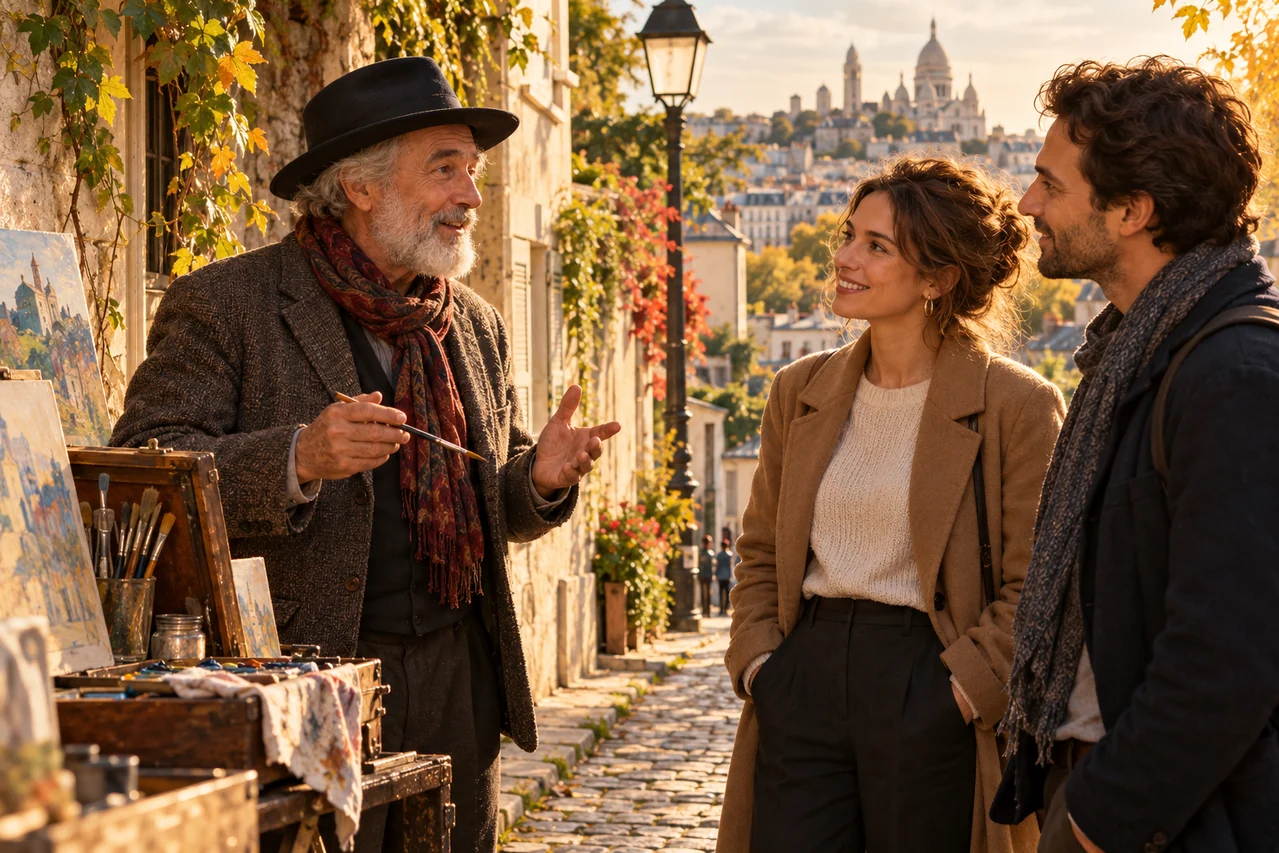
There is more than one artistic Montmartre
Renoir, Van Gogh and Picasso belong to different moments and do not represent a single movement. The district's image combines those moments so effectively that chronology can disappear. Starting with that distinction makes the neighborhood clearer, not less appealing. Impressionism is an important chapter within a longer story of modern art. Van Gogh is generally associated with Post-Impressionism; Picasso belongs to later developments. A well-told walk preserves that progression instead of calling every painter of the Butte an Impressionist.
Meet someone who supplied the work
Julien François Tanguy, born in 1825, became a color merchant associated with artists who later achieved great recognition. His activity connected practical supplies with the circulation of works and relationships. Who Père Tanguy was matters because his viewpoint differs from ours: a painter entering a shop was a person needing materials, not a guaranteed future museum name. The nickname conveys familiarity, but should not turn the merchant into a purely legendary father figure detached from a real commercial activity.
A painting begins with material needs
Before an image reaches a museum, somebody has to obtain paint, brushes and canvas, find space and sustain the time needed to work. Those constraints are easily forgotten when a masterpiece appears alone on a wall. Tanguy's story brings them back into view. Arrangements between artists and suppliers could matter significantly when money was short. Poverty should not be romanticized as artistic atmosphere: it could prevent work. The material perspective gives creativity a more substantial context than the image of inspiration arriving spontaneously.
The neighborhood supported a network
Montmartre offered living and working conditions that could be more accessible than some central districts, alongside cafés and informal sociability. Artists encountered peers, subjects and opportunities within that environment. Why Montmartre attracted artists involves geography and economics as well as charm. The streets connect activities rather than simply separate famous addresses. Seeing that network helps visitors understand how a place can support creativity without assuming that every conversation produced a masterpiece or that all residents experienced the same conditions.
Modern life became something to paint
The Moulin de la Galette brings Renoir's interest in leisure, light and sociability into a concrete setting. A scene of people dancing and meeting could become a major artistic subject without being recast as mythology or heroic history. This shift is part of what made modern painting challenging to established expectations. The place becomes more than a recognizable background: it allows visitors to consider why the everyday life around artists deserved attention and how a painting transformed that observation.
Van Gogh shows a wider artistic connection
Van Gogh's portraits of Tanguy make the supplier himself visible in art history. Japanese prints in the backgrounds of some versions also reveal international influences circulating through Paris. The relationship links a Dutch artist, a Paris merchant and another visual tradition without making their positions identical. It is a useful reminder that artistic innovation was not contained within a single national style. Van Gogh's inclusion broadens the story, but does not turn him into an Impressionist.
Later places require a move forward in time
The Bateau-Lavoir is especially associated with Picasso and an early twentieth-century generation, while the Lapin Agile adds a history of creative sociability across disciplines. Montmartre's three contrasting artistic places explain how these settings relate without pretending they all belong to Tanguy's own moment. An Encounter's historical perspective must remain distinct from later contextual explanation. Those transitions allow the district to reveal successive creative energies rather than a timeless community of every famous artist at once.
Continue from networks to landscapes
Père Tanguy can introduce a museum visit or a longer itinerary toward Monet at Giverny and Van Gogh at Auvers-sur-Oise. The relationships with place are different: Paris offers networks and urban life, Giverny a cultivated environment, and Auvers a late biographical chapter. Advisors can use those differences to create progression rather than repetition. For repeat visitors and art enthusiasts alike, the value lies in seeing painters as people working under particular conditions before later fame made their importance appear self-evident.
FOR YOUR GUEST ITINERARIES
For guests interested in art or a deeper return to Montmartre, ask Elyrea how an Encounter with Père Tanguy can introduce a wider artistic itinerary.
Discuss your itinerary