
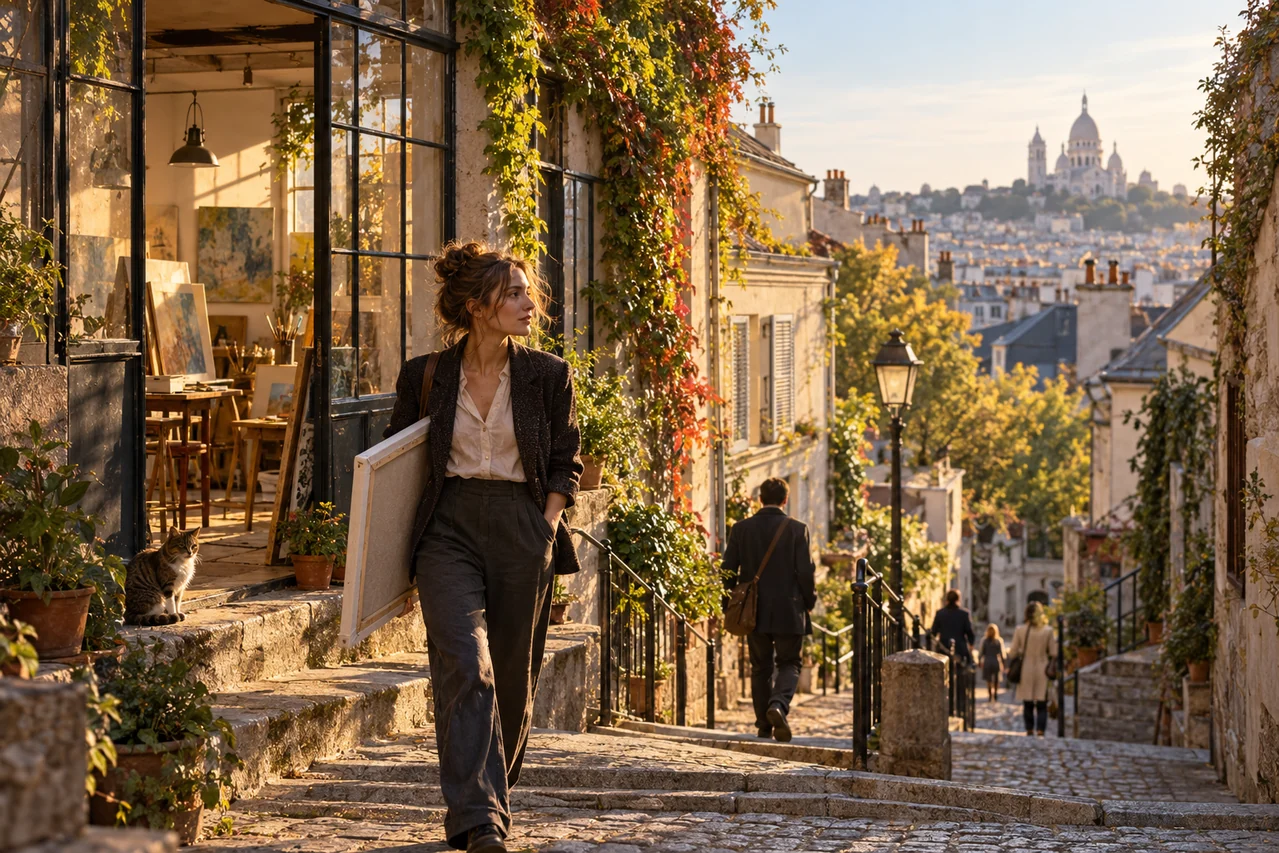
The Butte differed from central Paris
Montmartre's hill, mills and less densely built areas gave it a distinctive character compared with more central and affluent neighborhoods. Artists and other residents could encounter a setting at the meeting point of urban life and more open spaces. The later tourist image should not be projected backward unchanged. Understanding that earlier landscape explains why the district offered particular possibilities. It was not simply selected because it already looked like the romantic Paris visitors now expect to find.
Affordable space mattered to creation
Artists needed somewhere to live and work before their paintings brought reliable income. Areas with more accessible costs could therefore attract people starting careers or facing uncertainty. This connects art history with the practical geography of housing and studios. It does not mean every painter in Montmartre was poor, or that difficulty improved their work. It shows that creativity requires conditions, and that the location of an artistic community can be shaped partly by the cost of sustaining daily activity.
Networks made the attraction grow
As artists gathered, they helped create a setting where others could find peers, suppliers, models and places to exchange ideas. The network became a reason to come in its own right. Père Tanguy's role as a color merchant illustrates one practical element within that environment. The attraction was cumulative rather than magical. A neighborhood supported creativity through many ordinary relationships, not just a collection of exceptional individuals who happened to prefer the same picturesque streets.
Social places were working environments too
Cafés, cabarets and places of entertainment offered observation, discussion and contact between disciplines. Their historical importance extends beyond drinking or the anecdotes of famous patrons. Artists could find contemporary subjects as well as company there. The Moulin de la Galette demonstrates that relationship through Renoir's scenes of leisure. A visitor gains more by considering what such places enabled than by looking for an allegedly exact chair occupied by a celebrity. Social infrastructure formed part of creative life.
Modern life supplied pictorial subjects
Streets, dancing and gatherings became worthy of serious artistic attention. Montmartre provided material for painters interested in the present rather than only the historical and mythological subjects associated with established hierarchies. Renoir's work offers a clear connection with Impressionism, but the neighborhood was never restricted to it. What changed in Impressionist painting includes this shift of attention, alongside light and the visible handling of paint. Place and artistic choice become more intelligible when seen together.
Later artists changed the story
Van Gogh's Paris years in 1886–1888 introduced him to new color and artistic influences, while Picasso's association with the Bateau-Lavoir belongs to the early twentieth century. Neither should be called an Impressionist. The succession shows a district capable of attracting different generations, not a single group working simultaneously. The Moulin de la Galette, Bateau-Lavoir and Lapin Agile make that sequence concrete, allowing a compact area to reveal several stages of artistic change without flattening them into timeless bohemia.
A reputation can alter the place that created it
Artists' presence helped give Montmartre a cultural identity that later attracted entertainment, commerce and visitors. The district began to circulate an image of its own creative life. That process could change the conditions that originally made it attractive. The Sacré-Cœur also transformed the hill's skyline over its long construction history. Today's view is therefore not a preserved snapshot of the artistic past. Seeing layers and changes is more credible than claiming that nothing has happened since the famous painters lived there.
Read traces rather than seek a frozen past
Streets, perspectives and buildings still allow visitors to connect with Montmartre's artistic history, even when their functions and surroundings have changed. A Père Tanguy Encounter gives those traces a human and material framework through supplies, support and uncertain recognition. Advisors can use the subject for repeat visitors or art enthusiasts, balancing explanation with time to observe. The aim is to understand why the district mattered and how it changed, rather than promise a hidden neighborhood untouched by modern tourism.
FOR YOUR GUEST ITINERARIES
For guests who want to understand Montmartre beyond its familiar image, our team can help make an Encounter with Père Tanguy a meaningful part of their Paris stay.
Discuss your itinerary