
Court fashion created demand and influence
The French court helped disseminate styles and luxury goods under the monarchy. Clothing and accessories participated in the representation of rank, power and taste, sustaining demand for specialized work. Marie-Antoinette and Rose Bertin belong to a later chapter of that relationship between fashion and public identity. This does not mean that modern haute couture existed at Versailles in its later professional form. It means that court consumption and skilled production form part of the longer background. For visitors, beginning here makes fashion a subject of political and social history before it becomes a story of individual designers.
The nineteenth century changed the role of the couturier
Charles Frederick Worth, working in Paris, is central to the nineteenth-century development of a couture world in which the creator's name and artistic authority became increasingly important. That shift changed the relationship between clothes, clients and authorship. A garment could be associated with a house and a recognizable creative vision, rather than understood only as something made to a customer's instructions. The city supplied the conditions in which this role could grow. Dior's later prominence becomes clearer when placed within that development: he inherited an industry where the designer's identity already had international cultural and commercial significance.
International clients made Paris more than a local market
Aristocratic and wealthy clients traveled to Paris to order clothes, associating the city with a particular idea of elegance. This international demand preceded Dior and helped sustain the professional world he entered. Couture sold an object, but it also sold a relationship with Parisian taste. A visitor can therefore understand the capital as both a place of production and a place whose reputation circulated abroad. For American and other international travelers, the connection is especially relevant: the fashion history of Paris was never made exclusively by Parisians for Parisians. Customers and audiences elsewhere were part of its reach and development.
Specialist craft made creative ambition possible
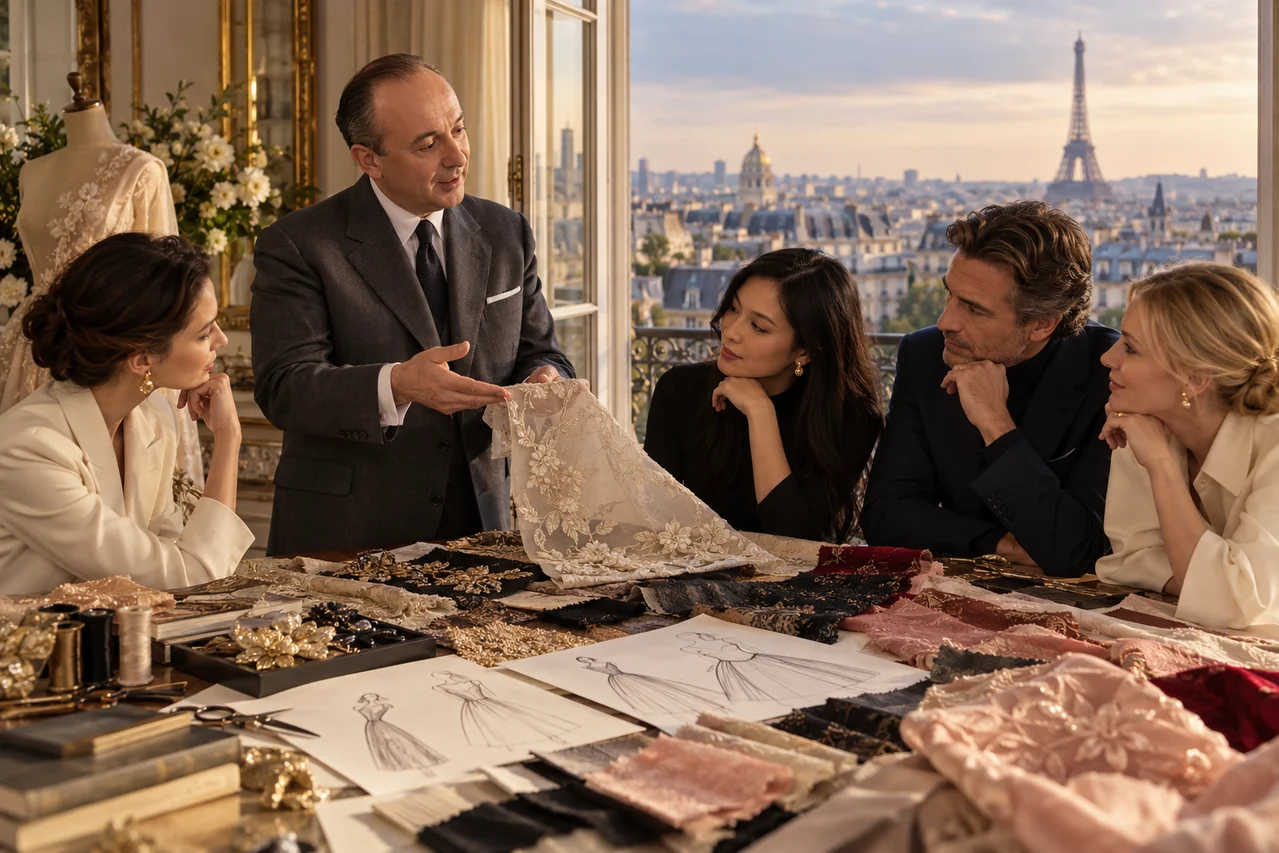
An ecosystem of embroiderers, milliners, feather workers, shoemakers and other specialists supported the city's fashion houses. Their knowledge allowed designers to propose effects that a single general workshop could not necessarily produce alone. This concentration of skills is less visible than a famous facade but essential to understanding Paris's role. Inside a couture atelier, the same lesson appears at the scale of a garment: artistic intention becomes material reality through collaboration. At the scale of a city, proximity between different professions helps make an industry possible. Cultural visitors gain more from recognizing that network than from memorizing a list of labels.
Chanel showed that Paris could revise its own codes
Gabrielle Chanel contributed to changes in women's clothing during the twentieth century, including approaches associated with movement and new uses of materials such as jersey. Her significance is not that Paris suddenly discovered modernity through one person. It is that the city's fashion world could generate competing propositions about how women might dress. The contrast with Dior becomes useful only when their different generations and historical settings are preserved. Comparing Chanel and Dior opens that discussion without treating either as the sole representative of freedom or constraint. Parisian couture history contains disagreement within it, not a single continuous definition of elegance.
The press continually reproduced the capital's reputation
Magazines, photographers and journalists turned collections into images and stories that traveled widely. Paris's authority was therefore supported by making and by communication. Carmel Snow's association with the expression New Look is one clear example of reception helping to define a fashion event. Readers elsewhere encountered the city through selected silhouettes and memorable descriptions. For a traveler, this mechanism explains why a neighborhood can feel familiar before a first visit. Its image has been encountered through media long before its streets are walked. An itinerary can then move beyond that image by revealing the people and work behind it.
Dior supplied a powerful postwar chapter
The international impact of Dior's 1947 collection contributed to renewed attention toward Paris after the war. It supplied a compelling image of change while the industry and the city were rebuilding. Its significance depends on that timing as well as on the design. Dior did not create the couture ecosystem or restore it alone; he became an exceptionally visible figure within it. That distinction allows the Paris of the New Look to be understood as a collective historical moment. The famous collection is a focal point through which wider questions of trade, craft, gender and cultural prestige can be explored.
A distinctive history within an international fashion world
Paris should not be described as the only city with creative authority. Milan, London, New York and other centers belong to the broader history of fashion. The particular interest of Paris lies in its couture heritage and accumulated relationships between houses, crafts and cultural institutions. For an Elyrea itinerary, this can become a sequence of distinct chapters: court representation through Marie-Antoinette, an earlier twentieth-century perspective through Chanel, and postwar reconstruction through Dior. Fashion beyond shopping offers a wider planning frame. The purpose is to explain a city's specific contribution while leaving room for the international world that helped shape it.
FOR YOUR GUEST ITINERARIES
Building a fashion-focused French itinerary for your guests? Elyrea can connect Marie-Antoinette, Chanel and Dior through distinct cultural encounters that explain different chapters of Parisian style.
Discuss your itinerary