
Begin with the difference in chronology
Gabrielle Chanel had established a major part of her career before the Second World War. Christian Dior founded his house in 1946 and made his celebrated debut in 1947. They did not offer their best-known propositions at the same point in social history. This matters because clothes respond to changing expectations, materials and ways of living. A comparison that begins with two photographs alone can erase those circumstances. Start instead with the questions each designer was addressing in a particular period. Dior's postwar setting provides one side of that historical frame, rather than treating his silhouette as an abstract declaration against Chanel.
Movement and structure offer a useful comparison
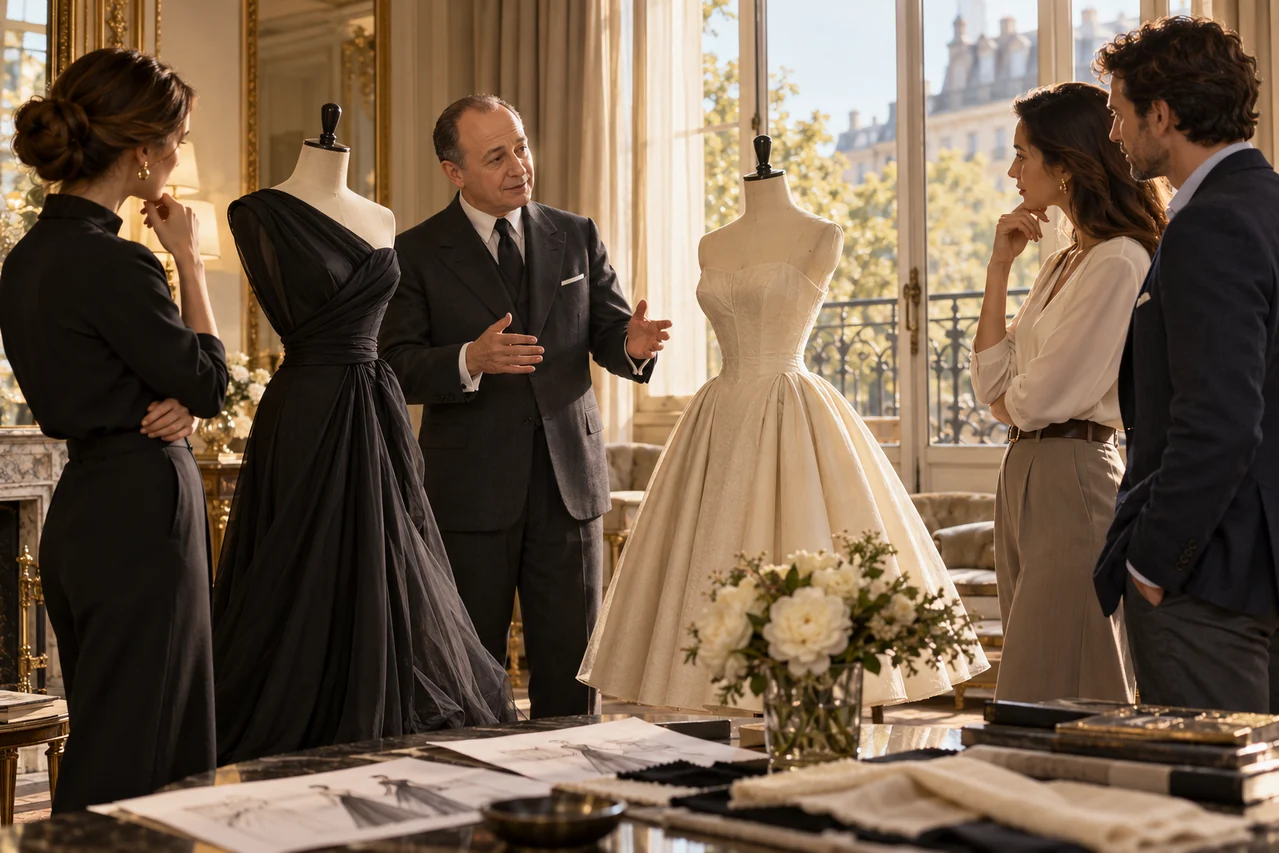
Chanel is associated with approaches that facilitated movement and with materials such as jersey used in new fashion contexts. Dior's New Look is associated with a defined waist and carefully organized volumes. These differences offer a productive way to examine clothes: how does the garment relate to the body, what does it emphasize, and what kind of movement does it allow? The comparison should remain specific rather than becoming a universal claim about every creation by either designer. Both careers contain variety and development. Looking at actual garments or documented silhouettes prevents a convenient shorthand from replacing the work itself.
Freedom and constraint are not complete biographies
Describing Chanel as freedom and Dior as restriction can produce an appealing contrast, but it is too reductive. Women could experience the same silhouette differently, depending on their preferences and circumstances. The New Look attracted criticism over bodily constraint, yet it was also desired and admired. Clothes may bring pleasure, social identity and physical demands together. A cultural encounter can let guests consider those tensions without deciding in advance that one designer represents progress and the other regression. This is especially valuable for travelers interested in the history of women, because the discussion preserves individual responses rather than turning women into a uniform audience.
Treat famous statements carefully
Chanel's criticism of fashions she regarded as constraining belongs to the comparison, but widely circulated quotations can acquire a life separate from their documentation. There is no need to repeat an unverified line to make the aesthetic disagreement intelligible. Proportions, materials and contemporary reception already offer substance. For an advisor, the most useful comparison connects documented designs and contemporary reactions, giving guests substance beyond a dramatic rivalry. A discussion can remain memorable while acknowledging complexity. The useful question is what each approach proposed for the wearer, rather than which dramatic remark makes the rivalry sound most entertaining.
Their careers briefly occupied the same fashion moment
Chanel returned to couture in 1954, while Dior was already internationally prominent; Dior died in 1957. That overlap allows a comparison of coexisting visions, but it does not make their entire careers symmetrical. Chanel's earlier history and Dior's later arrival still shape their perspectives. An itinerary can use these dates sparingly to orient the traveler. The aim is not to produce a timeline competition, but to show how a city can hold divergent creative propositions at once. The resulting account is more interesting than a duel because it reveals fashion as an environment in which multiple definitions of elegance can contend.
Both created recognizable visual worlds
Chanel's associations include the suit, the little black dress, jewelry and perfume; Dior became closely linked with distinctive silhouettes and an expanding house identity. Those familiar codes help explain how a name becomes legible to people who have never purchased couture. Neither world was made solely through a designer's individual hand: ateliers, specialists, clients and media contributed to recognition. The collective work of couture therefore belongs to both histories. Looking at codes alongside the processes that realize them prevents the comparison from stopping at personality. It also helps guests distinguish the historical creators from subsequent interpretations by their continuing houses.
Paris gives the comparison a physical geography
The Chanel story and the Dior story can be connected through Paris while preserving their individual settings. The Chanel encounter concludes at place Vendôme, before the Vendôme Column. Dior's founding history anchors the next conversation in the world of avenue Montaigne. These are narrative reference points, not grounds for pretending the two experiences form a single uninterrupted historical route. Travel time and the actual arrangements of each encounter need to be included when designing a day. The movement between neighborhoods can make the comparison tangible, provided the geography supports the content rather than replacing it with a sequence of famous luxury addresses.
Choose a question instead of a winner
A collector might compare construction; a student might consider creative identity; another traveler might explore how clothes reflect changing expectations of women. Those different questions give the same comparison different levels of depth. Elyrea's distinct Chanel and Dior encounters can support that personalized approach without making either a caricature of the other. For wider planning, Paris beyond shopping supplies a cultural frame, while a couture day for premium guests considers sequence and rhythm. The most rewarding conclusion is an informed view of more than one Parisian elegance, with the guest's own observations helping to shape the discussion.
FOR YOUR GUEST ITINERARIES
For guests who want to compare different ideas of French elegance, Elyrea can help you build distinct Chanel and Dior chapters into a Paris itinerary, with the content tailored to their interests.
Discuss your itinerary