
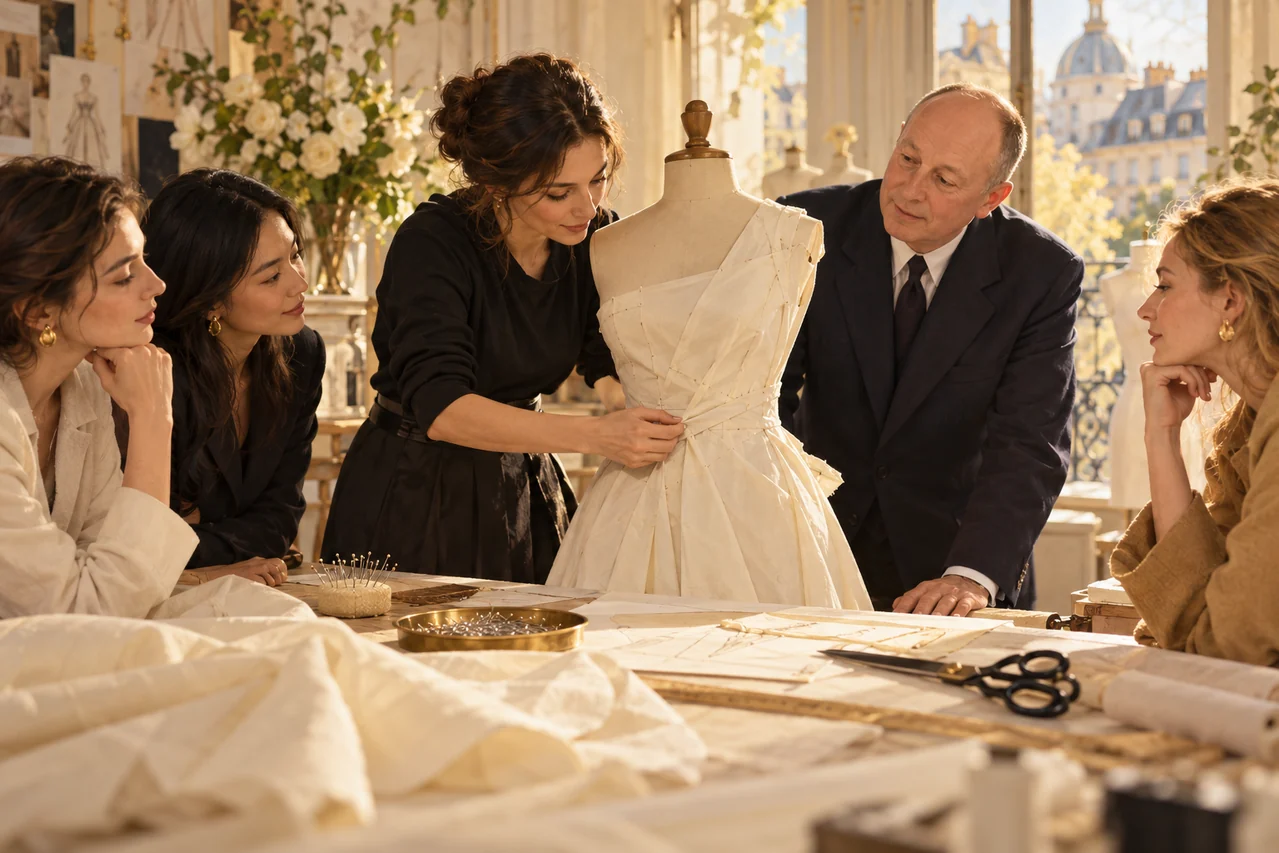
A sketch poses questions the atelier must solve
A fashion drawing communicates a direction, but paper does not settle how a garment will stand, fall or move on a body. Proportions that appear convincing in an illustration must be translated into three dimensions. The atelier brings experience to that translation: decisions about shape, material and construction can change how an idea becomes wearable. This is why the designer and workshop should not be imagined as separate stages with no dialogue between them. A drawing is a starting point for skilled interpretation. For a visitor, recognizing that gap between image and garment offers an accessible way into a highly specialized field.
The toile makes the idea tangible
Before final fabrics are used, a toile can help develop and adjust the form. Working through a trial version allows the team to test volumes and proportions rather than commit every decision immediately to valuable material. It also makes the process visible as something iterative. A finished garment may look assured, yet its shape can emerge through adjustment and discussion. This is a useful distinction for guests who associate couture principally with the spectacle of a runway image. Behind the image lies a working object, examined and changed until the relationship between intention and construction becomes convincing.
Different garments need different skills
Couture workshops have historically distinguished areas including flou and tailleur: expertise associated with softer garments such as dresses, and with more structured pieces. The categories help reveal how much variety hides inside the general word sewing. Handling a flowing fabric and constructing a sharply defined jacket can require different kinds of judgment. The skills are not interchangeable simply because both produce clothing. A visitor can begin to read an outfit through those distinctions, looking for softness, structure and the means by which each is achieved. Dior's New Look is a useful example because its familiar silhouette raises both questions.
The expertise behind the phrase petites mains
The traditional expression petites mains is often used for highly skilled workshop workers. Its affectionate sound should not suggest minor or unthinking work. These are people whose judgment and practiced techniques make difficult garments possible. Without their contribution, a designer's intention would remain an image rather than a finished piece. Cultural interpretation should therefore give the atelier a visible place in the story and identify individual makers when reliable documentation permits. This matters to an international traveler because it replaces a vague idea of handmade luxury with a more accurate understanding of specialist labor, responsibility and accumulated knowledge.
Specialist trades extend beyond one workshop
Some creations involve embroidery, feathers, artificial flowers, pleating, buttons or other decorative specialties. Such work can draw on dedicated craft businesses rather than being completed entirely within a single couture atelier. Paris's fashion history depends on this broader network. The spectacular surface of a dress may therefore hold several different professional contributions, each bringing distinct tools and knowledge. A cultural itinerary can help guests look for those layers without promising entry to a working workshop. Objects, exhibitions and carefully grounded explanation can make skills intelligible even when the making takes place elsewhere and remains outside the visitor's access.
Fitting connects technique with the wearer
Haute couture has historically depended on a precise relationship between garment and individual client. Successive fittings allow proportion and movement to be considered on a particular body. Personalization is therefore part of construction, not simply an optional final detail. This relationship also explains why a photograph cannot capture everything that matters: a garment must work in use, with the wearer's posture and movement. For travelers interested in design, the fitting process opens a discussion about how beauty is negotiated between an artistic proposition and a lived body. It is a technical conversation with human consequences, rather than a purely abstract exercise in form.
Time is specific to the garment
Complex pieces can demand considerable labor, particularly where elaborate surface work or difficult construction is involved. There is no honest universal number of hours that describes all couture. A dramatic figure without a documented garment attached to it gives an impression of knowledge without explaining anything. Better questions concern the tasks, repetitions and decisions involved in a particular piece. Why does an adjustment take time? Which detail requires specialist work? This approach gives guests a grounded understanding of value. It also respects craft by describing what makers do instead of reducing their expertise to a large number designed to impress.
Use Dior to reveal collective creation
Christian Dior offers a recognizable character through whom the less familiar world of the atelier can be introduced. The designer sets an artistic direction, but many people give that direction material form. La mode selon Dior can make those relationships part of a cultural encounter while keeping the historical founder distinct from later developments at the Maison. For advisors, a craft-conscious couture day provides a practical extension; the history of Paris as a fashion center explains the wider ecosystem. The result is an itinerary in which the guest learns to see knowledge, collaboration and time inside a finished garment.
FOR YOUR GUEST ITINERARIES
For guests fascinated by craftsmanship, Elyrea can help you use La mode selon Dior as a cultural introduction to the skills behind couture. Ask our team about a relevant itinerary; any separate workshop access requires its own confirmation.
Discuss your itinerary