
Start with the proportions
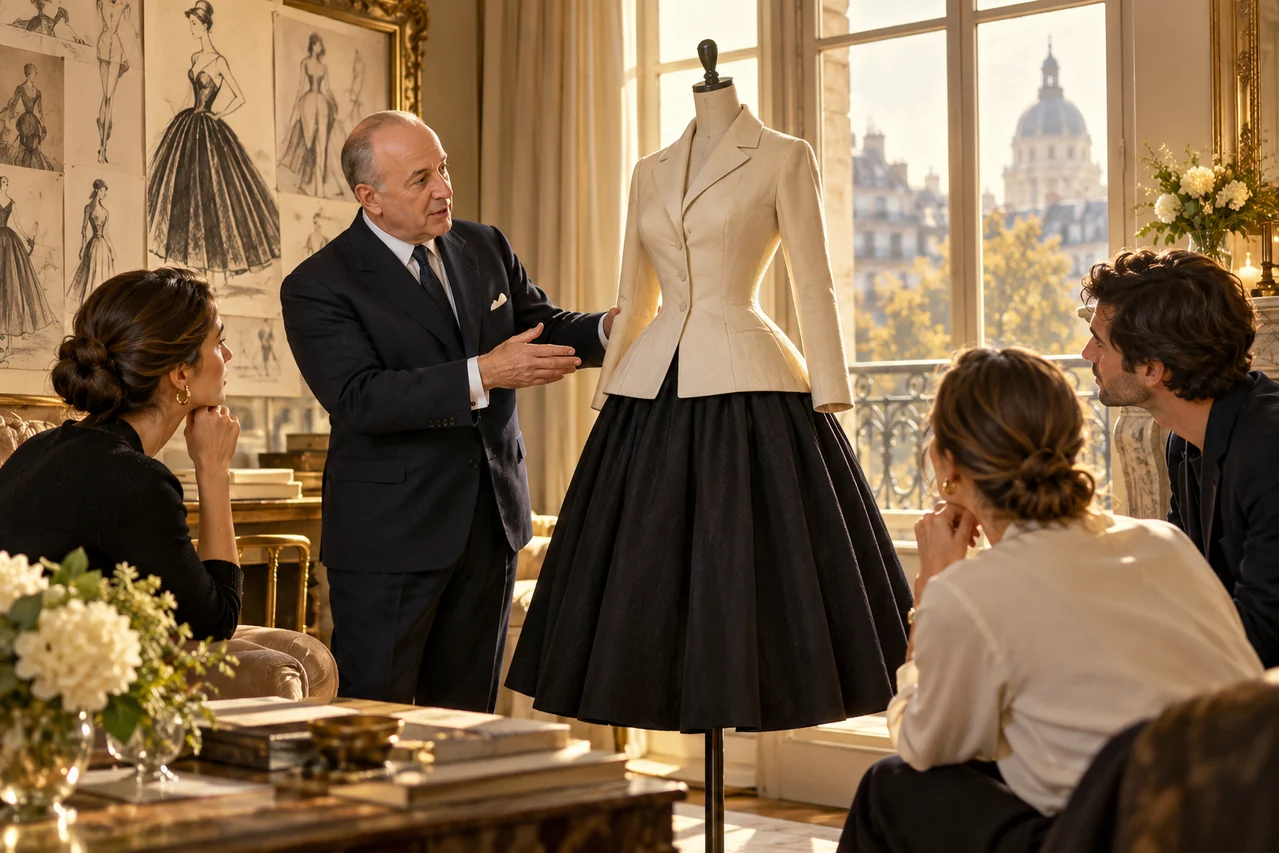
The New Look is most readily understood through a relationship of shapes: a clearly marked waist, a shaped upper body, relatively soft shoulders and skirts that could be strikingly full. The Bar ensemble became one of the best-known representations of those proportions. Rather than beginning with a slogan, look at how the garment directs the eye and organizes the body. A visitor does not need specialist vocabulary to see that the silhouette is deliberately constructed. The apparent ease of a finished outfit conceals choices about volume, balance and support, all of which become more legible when the piece is considered as design.
Why the contrast with wartime clothing mattered
The preceding years had brought restrictions and material constraints. Clothing often reflected the need to economize or function within changed circumstances. Against that background, the generous use of fabric in parts of Dior's collection had a force it may not carry for a viewer today. The contrast was not simply between two hemlines or two tastes: it was between recent experiences of limitation and a proposed image of abundance. This is why Dior's postwar Paris belongs beside the clothes in any thoughtful interpretation. Context restores the shock that an isolated museum photograph can turn into familiarity.
A collection received its memorable name
The expression New Look is traditionally credited to Carmel Snow, editor-in-chief of Harper's Bazaar, following the presentation. The distinction matters: a designer presents a collection, and the media provide a phrase through which it circulates. A short, memorable label can compress a complex creative event into an international story. Photography and fashion journalism then carry that story to readers who will never order a couture garment. The naming of the collection therefore belongs to its history rather than serving as a decorative anecdote. It demonstrates how modern fashion depends on interpretation and communication as well as on making clothes.
Admiration did not erase resistance
The generous consumption of fabric attracted criticism while the memory of scarcity remained close. Other objections focused on the constructed female silhouette and the constraints it might impose. These reactions prevent the New Look from being described as a liberation accepted by everyone. Some women found the image desirable; others saw a problematic direction. Both responses can coexist within an account of its success. For a visitor interested in the history of women, this tension is especially revealing. A fashionable appearance can express pleasure, social expectation and bodily restriction at the same time, rather than belonging neatly to one moral category.
Innovation within an existing fashion world
Dior did not create his proposal outside all precedent. Designers worked within overlapping visual traditions and responded to a wider environment in which silhouettes were changing. The significance of his collection lies in the coherence and international impact of the proposition, rather than a claim that nobody had previously imagined a shaped waist or a full skirt. This distinction does not diminish his achievement. It explains why historical influence is more complex than awarding a single inventor's title. Dior assembled a persuasive vision at a moment when a new house, Parisian couture and an international audience could make it resonate.
The Bar ensemble became a visual shorthand
The Bar ensemble is especially effective as an image because its jacket and skirt make the collection's proportions immediately readable. As photographs, museum presentations and fashion histories returned to it, one outfit increasingly stood for a broader event. Visitors should still remember that a collection is larger than its most famous example. An icon is a useful entrance, not a complete inventory. Looking closely at the Bar silhouette can lead toward the work of the couture atelier, where an apparently simple outline becomes a demanding problem of construction, fitting and the relationship between material and body.
Influence traveled beyond couture clients
The collection's reach exceeded the small world of people able to commission haute couture. Its proportions were discussed, adapted and absorbed into wider representations of femininity. An international fashion moment can influence clothes made elsewhere and images circulated far from the original workshop. This helps explain why 1947 remains a meaningful date even for travelers with no personal connection to couture consumption. The event contributed to renewed attention toward Paris, although the recovery of the city's fashion industry was collective. Dior supplied an exceptionally visible chapter within that renewal, rather than restoring an entire industry single-handedly.
Read a silhouette as a historical argument
A contemporary visitor can recover the force of the New Look by asking what people saw in it at the time: abundance, beauty, constraint, renewal or commercial opportunity. Those different readings make it a useful cultural subject. La mode selon Dior can connect the designer's choices with the people and circumstances around him, while preserving the difference between historical evidence and the narrative voice of an encounter. For a broader comparison, Chanel and Dior's approaches to elegance opens a related discussion. The value is not in deciding which designer wins, but in understanding why a garment could change what people argued about.
FOR YOUR GUEST ITINERARIES
Are your guests interested in the moments when design changes a culture? Elyrea can help you place La mode selon Dior within a Paris itinerary exploring the New Look and its postwar context.
Discuss your itinerary