
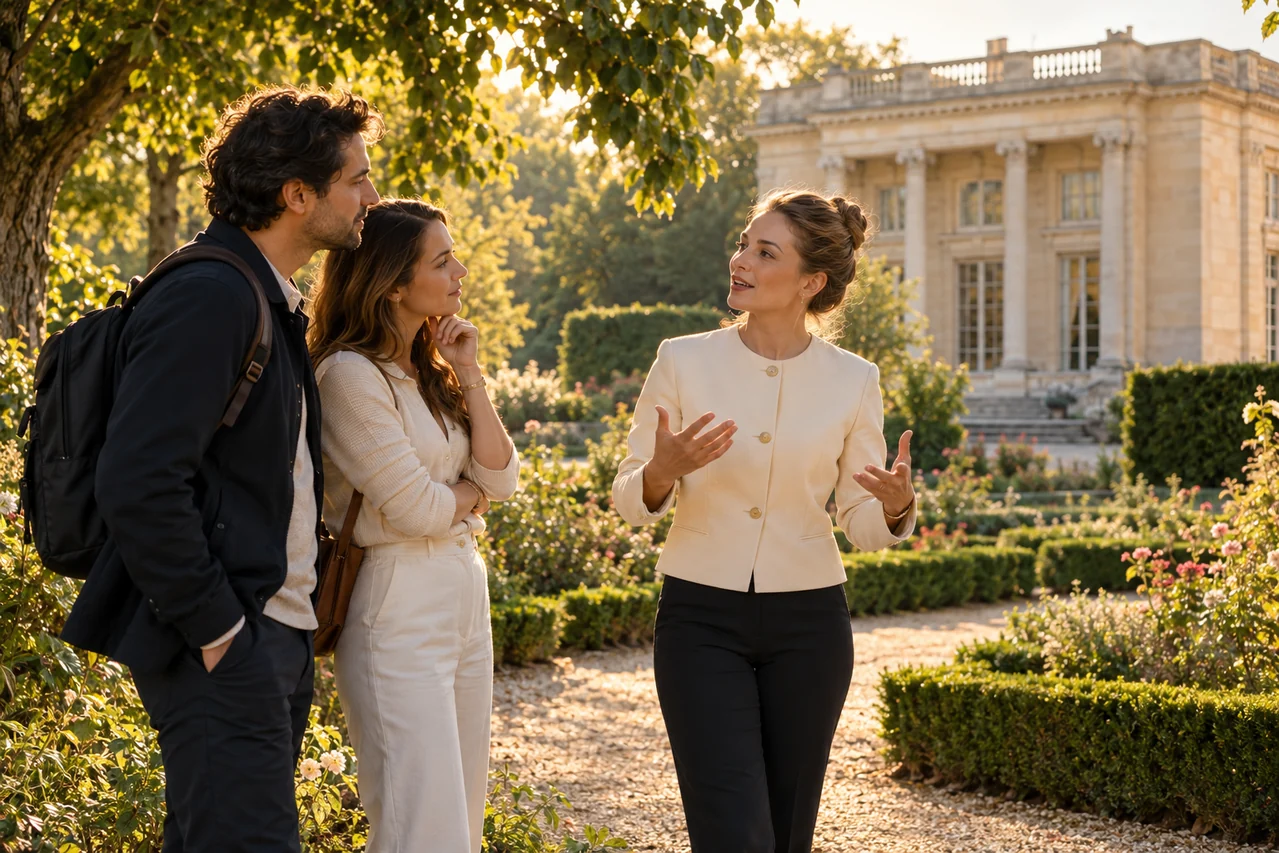
The Petit Trianon existed before Marie-Antoinette
The Petit Trianon was commissioned under Louis XV and designed by Ange-Jacques Gabriel. It was not built from the beginning for Marie-Antoinette. Louis XVI gave her use of the property after his accession, and she made it closely associated with her own life and image. This chronology matters because a familiar place can acquire a later identity so completely that its earlier story disappears. Understanding what she inherited and what she changed gives a more accurate starting point than treating the entire setting as the creation of a personal caprice.
A change of scale could change the experience of life
Compared with the main palace, the Petit Trianon offered a more contained architectural and social environment. That difference was not only aesthetic. In a court shaped by rank, ceremony and constant representation, a smaller setting could permit a different rhythm and a more selected circle. A traveler can use the contrast to ask what it meant to inhabit Versailles, rather than simply compare two beautiful buildings. The tension between palace life and personal autonomy gives this change of scale a useful human context.
Choosing companions also redistributed access
Marie-Antoinette could exercise more control over the people admitted into her Trianon world. For her, that might create relative freedom from the larger court; for those excluded, it could mean loss of proximity and influence. Choosing company was therefore not completely private. The same action could be understood as a personal preference or a political signal, depending on the observer's position. This helps explain both her attachment to the setting and its place in controversy, without requiring the visitor to decide that one interpretation cancels the other.
Privacy remained an expression of exceptional privilege
A queen seeking personal space did so through resources unavailable to most people. The Petit Trianon should not become a setting for imagining Marie-Antoinette as an ordinary person escaping ordinary social pressure. Her wish for intimacy was real in its historical context, but the material form it took was royal. Holding those dimensions together prevents both romantic idealization and a purely dismissive account. The visitor can understand why the place mattered to her while recognizing the social distance represented by the freedom to shape such an environment.
Taste becomes visible in more than clothes
Interiors, gardens, social arrangements and entertainment can reveal preferences that an official portrait does not. The Petit Trianon gives guests interested in design or fashion another way to consider Marie-Antoinette's aesthetic world. It should not be read as a complete psychological portrait: a chosen environment reveals some things and leaves others unknown. The relationship between taste and display is nevertheless rich. A queen could construct a more personal atmosphere while remaining observed, interpreted and represented through the very choices intended to make that atmosphere her own.
The theater adds another dimension to her interests
The theater associated with the queen's domain recalls the place of performance and entertainment within her smaller social world. It helps visitors move beyond the stillness of formal portraits toward a person interested in playing, watching and participating. Explain this cultural dimension without making unsupported claims about particular scenes or promising entry that has not been arranged. The subject can deepen an account of the domain's social life, showing how pleasure, artistic practice and selected company belonged to a different rhythm from the main court's public ceremonies.
A refuge could become a political symbol
The Petit Trianon was seen differently from outside the queen's circle. It could suggest withdrawal, favoritism or distance from expected royal duties. The reasons for Marie-Antoinette's unpopularity show how personal spaces and choices entered a much wider reputation. The visitor should notice this divergence rather than assume that a private setting automatically tells the most authentic story. Trianon helps reveal her preferences, but it also reveals how others used those preferences to construct an image over which she had limited control.
Give the place enough attention in a queen-centered day
For a first-time Versailles visitor with limited time, the main ceremonial spaces may take priority. In a journey specifically focused on Marie-Antoinette, omitting the Petit Trianon removes a major part of the question about privacy and representation. An Encounter can prepare that question before the visit or provide a discussion afterward. Planning a Marie-Antoinette day at Versailles should give the property a clear role and adequate time, alongside independently confirmed practical arrangements. It becomes a key to the queen's contradictions rather than a charming addition at the end.
FOR YOUR GUEST ITINERARIES
Creating a Marie-Antoinette day at Versailles? Our team can help connect Marie Antoinette, Rebel Queen with the questions your guests will explore at the Petit Trianon.
Discuss your itinerary