
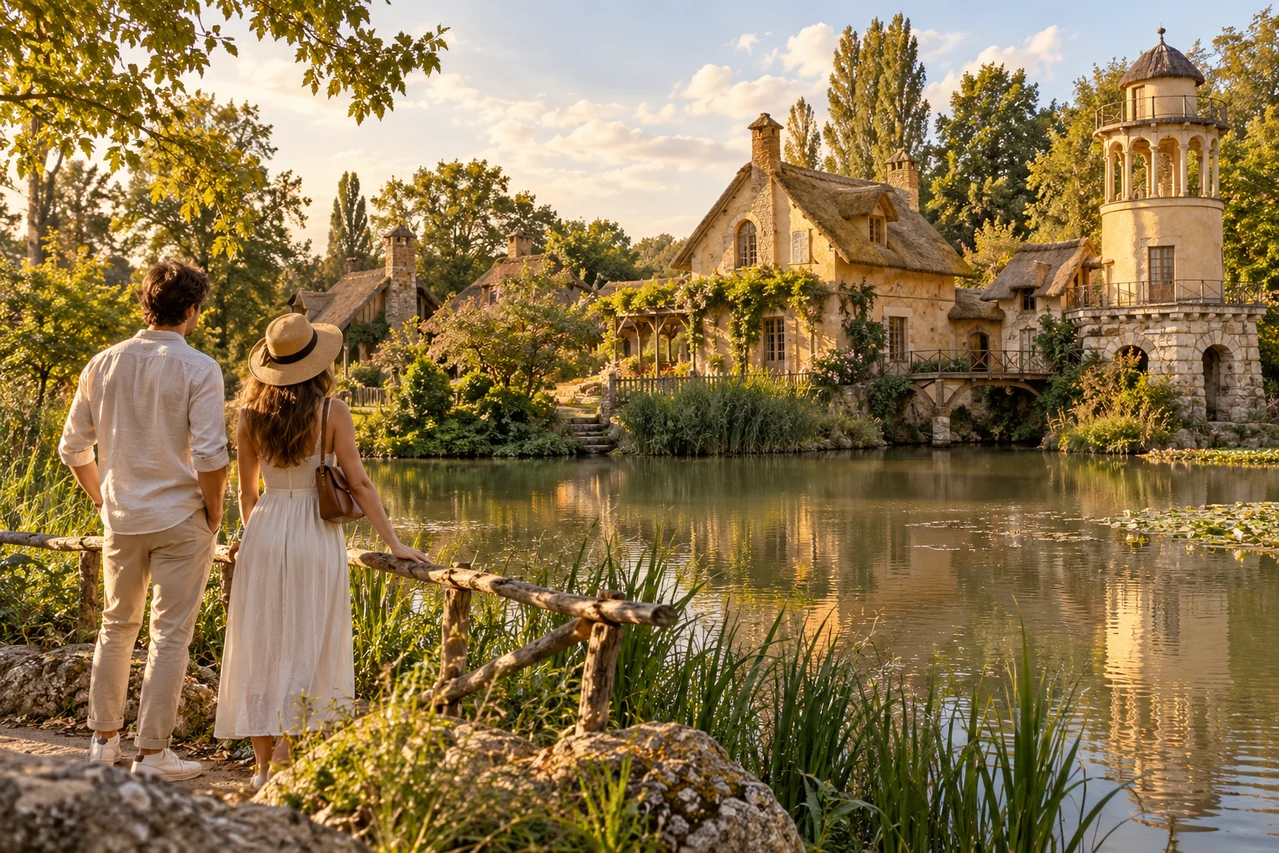
Begin with the landscape rather than the familiar verdict
The Hameau belongs to the Trianon domain and deliberately contrasts rustic appearance with the formal scale of Versailles. Its setting relates to eighteenth-century interest in picturesque gardens and idealized nature. This does not make it an ordinary rural settlement. It remains a carefully created royal environment. Starting with the landscape helps travelers understand what they are looking at before assigning a moral conclusion. The question becomes how this kind of place worked within aristocratic culture, not simply whether its appearance proves an accusation against the queen.
The popular farming story is an inadequate description
The image of Marie-Antoinette dressing as a poor farmer and conducting everyday agricultural life belongs largely to popular legend. It should not be used as the literal explanation of the Hameau. The queen was not abandoning royal conditions for the experience of ordinary rural poverty. A more useful context is the cultivated appeal of country imagery among privileged circles. Correcting the caricature does not remove the social distance involved. It distinguishes a seductive later story from the historical framework necessary to understand the setting.
Privilege is still central to the place
The resources required to create a landscape for royal enjoyment represented an exceptional material position. A visitor can recognize that fact without accepting every claim made about how Marie-Antoinette used it. This double reading is important. It prevents correction of a myth from becoming an automatic defense of monarchy, while also preventing awareness of inequality from turning a caricature into evidence. The Hameau is historically richer when travelers can discuss privilege precisely, rather than use an entertaining anecdote as a substitute for analysis.
Nature offered a contrast within the royal world
The main palace organized representation on a monumental scale, while Trianon allowed a different atmosphere and a more selective social environment. The Hameau contributes to that contrast through its landscape and appearance. Why Marie-Antoinette valued the Petit Trianon establishes the broader relationship between place and personal choice. She sought greater control over aspects of her life as queen, not an exit from monarchy. The apparent simplicity of the setting therefore belongs within sophistication and power, rather than standing outside them.
Why the caricature became so persuasive
A queen surrounded by artificial rusticity provides a memorable contrast with a population facing economic difficulties. The resulting story is easy to tell because it seems to explain inequality through one image. That clarity can conceal how much has been omitted. The doubtful attribution of the brioche phrase offers a comparable lesson in how reputation attracts stories that fit it. Neither myth needs to be accepted for the underlying historical questions about royal privilege and political crisis to remain serious.
Read the Hameau as part of the history of reputation
The place tells two connected stories: the environment Marie-Antoinette helped shape and the image others constructed around it. The same setting can become a refuge, an aesthetic statement or a symbol of distance depending on the perspective. A visitor should not assume that one view is transparent truth and all others irrelevant. Explain which aspects can be established and which belong to later interpretation. This makes the Hameau a useful place for considering how tangible heritage becomes material for public narratives about a person.
Invite families to compare an idea with what they see
A family can begin by sharing what they think they know about the Hameau, then use the visit to examine that image. Which details suggest deliberate rusticity? What makes the place clearly different from an ordinary village? How does an attractive setting become a political symbol? These questions encourage observation without turning the experience into a quiz. The landscape remains pleasurable to explore, while its history gives adults and younger visitors a shared way to discuss the difference between a convincing story and an adequate explanation.
Connect the landscape with the encounter
Marie Antoinette, Rebel Queen can establish questions before a Hameau visit or provide a conversation after guests have formed their own impressions. Give the two experiences complementary purposes rather than repeating a verdict about the queen. A focused Marie-Antoinette day at Versailles should leave time to observe as well as listen. The most useful answer to caprice or freedom is not a simple choice between them: the place combines exceptional privilege with a desire for a less ceremonial environment, and those dimensions can coexist.
FOR YOUR GUEST ITINERARIES
Planning a Versailles itinerary that goes beyond royal clichés? Our team can help connect the Hameau's questions with Marie Antoinette, Rebel Queen.
Discuss your itinerary