
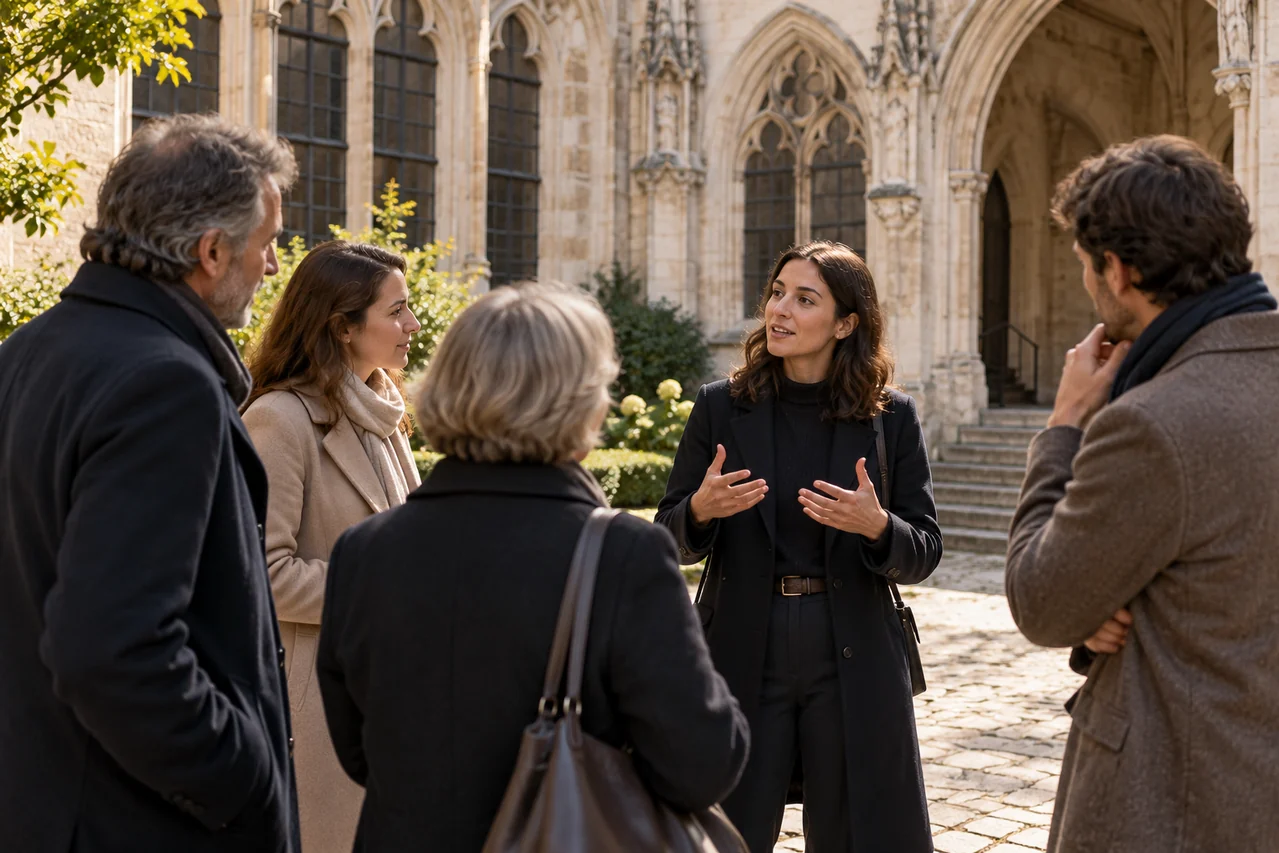
A guided visit offers a broad and organized framework
A skilled guide can explain Rouen's architecture, urban history and places associated with Joan while placing each in chronology. That breadth matters for visitors encountering the city for the first time. It helps distinguish surviving structures from later memorials and avoids reducing the destination to an execution site. The format can be detailed, responsive and engaging; calling it traditional should not imply that it lacks imagination. Its contribution is the organized relationship between place, evidence and historical context across a wider view of the city.
An Encounter changes the relationship with the trial
With an embodied Joan, accusations become questions addressed to a person within a narrative, rather than items explained only from a later historical vantage point. Participants can attend to replies, authority and the difficulty of defending a claimed mission. This is the distinctive contribution of the Encounter. It does not depend on hiding the familiar outcome or inventing a surprise ending. The tension comes from investigating how the proceedings moved toward that outcome, and what the accused person faced while it was still part of her present.
The historical material is rich, but performance remains interpretation
Questions and responses preserved from the case offer substantial material for narrative work. An incarnation also involves selection, reformulation and dramatic choices, which should not be confused with verbatim testimony. This distinction allows the format to be engaging without claiming impossible access to every private emotion or thought. The religious and political dynamics of the trial provide genuine tensions already present in the history. There is no need to turn the judges into caricatures or give Joan a fully modern vocabulary to make those tensions intelligible.
Rouen gives the character a necessary setting
The city relates Joan's captivity, trial, execution and later remembrance to actual places and traces. This geographical connection is central to the Encounter's cultural value. The same character in an arbitrary setting would not provide the same relationship between narrative and destination. A visitor can examine the distance between today's streets and the history being evoked, rather than imagining the entire city unchanged since 1431. Contextual walking and memorial places help sustain that connection, so the performance develops attention to Rouen instead of replacing it.
First-time and returning visitors need different balances
Guests new to Rouen may benefit from a broader guided introduction before the trial-focused Encounter. Those who already know the main landmarks might prefer deeper engagement with the case and its later reassessment. Neither approach needs to occupy every hour with commentary. The advisor should ask which understanding is missing from the guest's previous experience. A route through Joan's Rouen can then be adjusted accordingly, using selected places to support a progression rather than repeating an introductory survey beneath a different presentation style.
Families can engage through questions of judgment
Listening, comparing accusations and considering replies offer intellectual roles across generations. Teenagers may also respond strongly to Joan's age and the disparity between an individual and powerful institutions. The history remains serious: participation should not turn execution into a light-hearted game or erase the religious world in which the proceedings occurred. Appropriate context and reflection make the format suitable for a shared cultural conversation. Parents and children can leave with different emphases while understanding the same sequence of events and the limits of what they have reconstructed.
Match depth to specialist interests without flattening the story
Guests interested in law may explore jurisdiction, procedure and later nullity; religious travelers may examine claimed guidance and ecclesiastical authority; general history enthusiasts may focus on royal legitimacy and war. These interests overlap but do not require identical emphasis. The Encounter can serve a focused chapter within a wider day, while museum or guided interpretation provides other forms of context. Avoiding duplication matters more than choosing a supposedly superior format. Each should give guests a distinct contribution and enough time to absorb it.
Choose the combination that makes the case understandable
The question is what travelers should understand afterwards: the city, the trial's mechanics, Joan's position or the development of her memory. A considered itinerary can address several of these aims without including every available stop. The Elyrea Encounter provides a character and a participatory narrative center, while other formats supply complementary breadth. Premium value comes from appropriate interpretation and pacing rather than promises of closed doors or manufactured privilege. The memorable outcome is a more human and historically grounded understanding of Joan in Rouen.
FOR YOUR GUEST ITINERARIES
Choosing a Rouen experience for your guests? Elyrea can help you integrate the Joan of Arc Encounter alongside a guided visit or a broader itinerary around the city.
Discuss your itinerary