
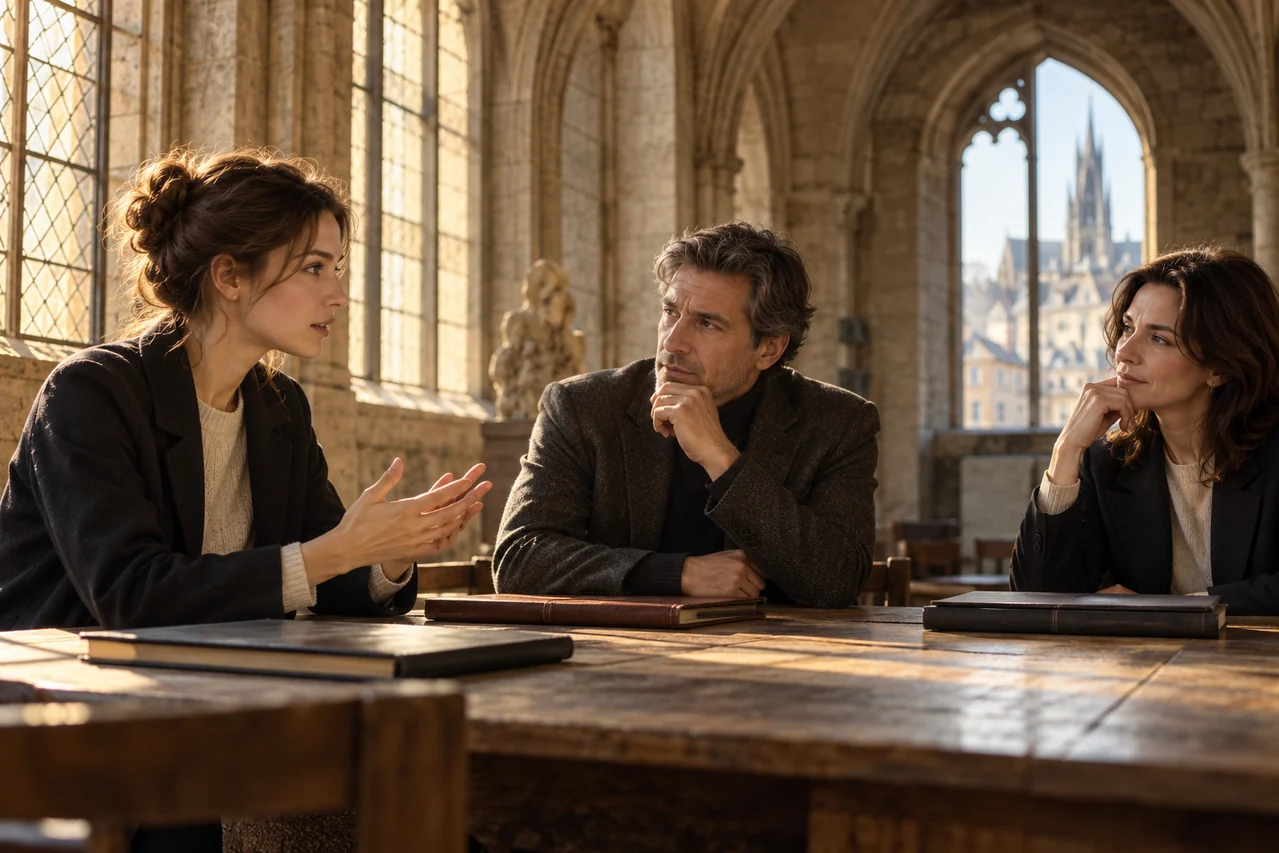
Political interests shaped the setting of the trial
Joan's support for Charles VII made her dangerous to the opposing side not simply as a military participant but as a figure associated with divine sanction. The English had an evident interest in discrediting that authority. She was held within an environment controlled by her adversaries, and the proceedings cannot be separated from this wartime imbalance. This is the starting point for examining manipulation. It does not require assuming that every participant believed exactly the same thing or that religious arguments carried no significance beyond public appearance.
Pierre Cauchon acted within institutions and alliances
Pierre Cauchon, bishop of Beauvais, played a central role in the proceedings and was aligned with the Anglo-Burgundian side. His position helps explain the relationship between ecclesiastical authority and political allegiance. Treating him only as a theatrical villain, however, narrows the analysis too far. The case also depended on accepted forms of inquiry, other participants and the effort to produce a judgment with religious legitimacy. Understanding the institution is essential: the question is how authority was exercised, not simply whether one judge possessed hostile intentions.
Theological questions could carry real consequences
Joan's voices, her claimed mission and her obedience to the Church were not minor details within a medieval ecclesiastical trial. They concerned the recognition of spiritual authority and the classification of belief. Questions could therefore be dangerous even when they sound remote to a modern audience. Joan faced trained clerics whose terms structured the conversation. Her answers deserve attention within that imbalance. A responsible account does not recast the exchanges as a modern courtroom drama with identical rights, vocabulary and expectations merely because the basic idea of judgment feels familiar.
Clothing brought several kinds of argument together
The discussion of men's clothing illustrates how practical behavior could be interpreted religiously. War, captivity, personal security and norms about gender all intersected in the issue. Its repeated appearance in the trial does not mean the entire condemnation can be explained by one garment. Why Joan wore men's clothing opens the detail more carefully. The broader problem is how an institution defines the meaning of an accused person's actions, especially when that person explains those actions through circumstances the judges may reject or interpret differently.
Abjuration and relapse belong to the judicial sequence
The proceedings involved an abjuration and the subsequent treatment of Joan as having relapsed. These stages mattered within the religious and legal logic through which the final condemnation became possible. They should not be skipped merely because the outcome is already familiar. Nor should disputed details be filled with invented certainty to make a narrative smoother. Following the sequence helps travelers understand the mechanics of the case: the judgment developed through categories and decisions, rather than appearing as one unexplained order to execute a captive opponent.
The later nullity proceeding changes the perspective
The condemnation was annulled in 1456 after a new examination undertaken in a changed political environment. Evidence and testimony from that later proceeding are important for understanding criticisms of the earlier trial. Yet the second process also belongs to its own historical circumstances. The overturning of Joan's conviction should therefore be read as a significant legal reassessment, not a magical removal of every uncertainty in the surviving evidence. Comparing both proceedings makes the case richer by showing how judgment, memory and power can change over time.
Explain manipulation without calling everything meaningless
The answer to whether the trial was politically manipulated lies in the combination of hostile context, unequal power and religious procedure. The formal structure did not neutralize political pressure, but neither was it an irrelevant decoration. That tension is precisely why the case remains instructive. Visitors can investigate who held authority, which questions mattered and what forms of legitimacy the participants sought. The result is more substantial than a predetermined verdict about villains and victims, because it examines the process that allowed a politically useful condemnation to function institutionally.
Make Rouen a setting for inquiry rather than easy analogies
The Joan of Arc Encounter invites questions about what constitutes guilt, who judges it and which rules apply. Its dramatic language should retain the religious and political world of the fifteenth century rather than place modern opinions unaltered in Joan's mouth. Guests interested in law, politics or institutional history can engage deeply without treating the trial as a direct equivalent of a current controversy. Rouen's locations and later commemorations anchor the discussion. A considered itinerary leaves participants with a historical problem they can continue examining after the visit.
FOR YOUR GUEST ITINERARIES
Have guests interested in history, justice or political power? Elyrea can help integrate the Joan of Arc Encounter into a Rouen visit built around the trial's central questions.
Discuss your itinerary