
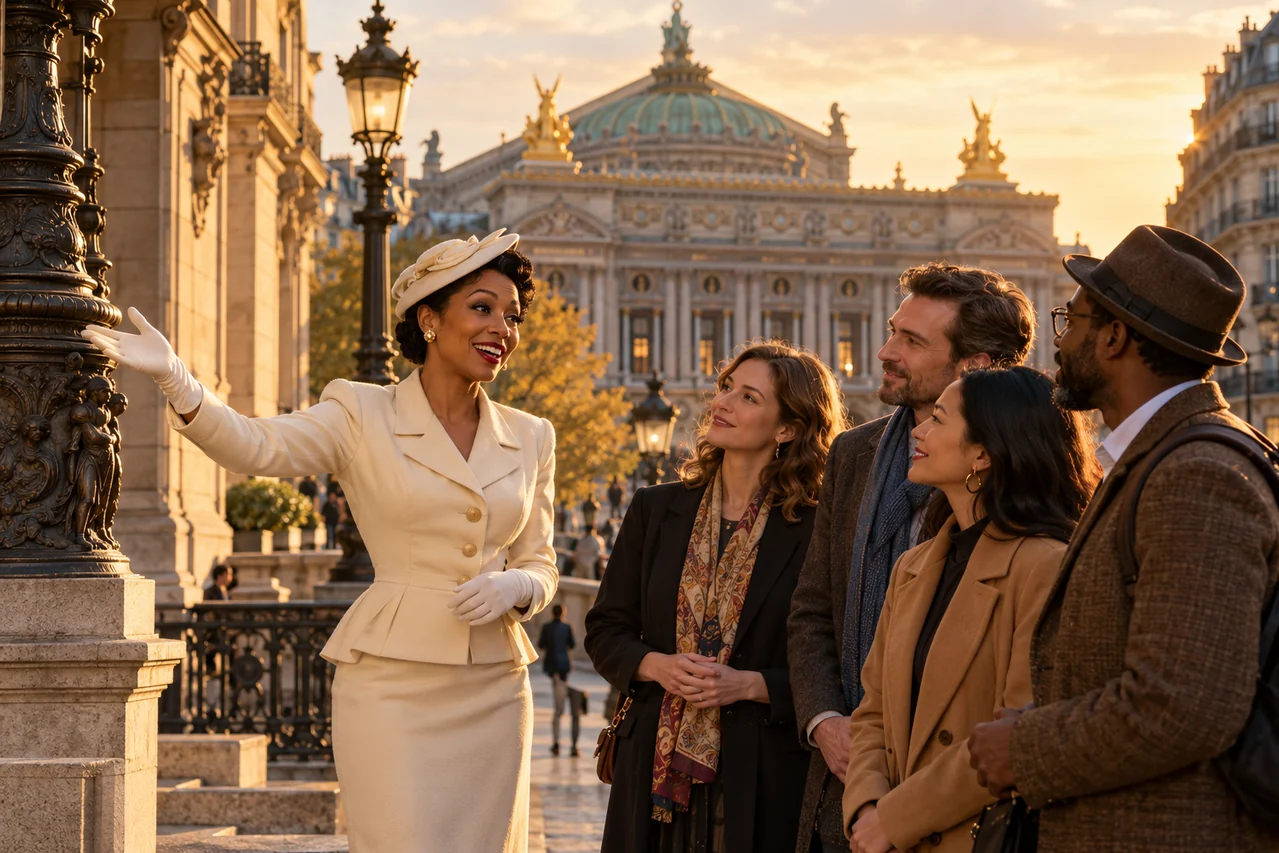
An American arrival that changed the story
Born in St. Louis in 1906, Baker grew up in a United States shaped by racial segregation. Her arrival in Paris in 1925 changed the possibilities available to her as a performer. That contrast helps explain the city's importance in her life, but it should not turn France into a place without prejudice. Her success belongs to a complicated history of opportunity, fascination and the public image projected onto a Black American woman.
The woman beyond the stage image
Baker's celebrity is a useful starting point because many travelers recognize it immediately. It becomes more interesting when recognition gives way to discovery: the performer was also a businesswoman, a French citizen and an internationally connected public figure. Keeping these identities together prevents the journey from dividing her into unrelated roles. The skills, contacts and confidence built through her career help explain what she could later contribute during wartime.
Choosing France in a time of danger
Baker became a French citizen in 1937. Her wartime engagement gave that connection another dimension when she supported intelligence activities and the cause of Free France. The meaning lies in the decision as well as the subsequent recognition. She did not know how the conflict would end. A responsible narrative restores that uncertainty instead of making her actions seem inevitable because visitors already know the outcome of the war.
What a Paris setting can explain
Prestigious squares, hotels and avenues can help visitors understand the geography of power and international society during the Occupation. Their present elegance makes the historical contrast especially striking. Yet a narrative route is not automatically a list of Baker's documented wartime addresses. Her actual activities extended beyond Paris. Distinguishing contextual locations from established biographical connections makes the city a more convincing setting and protects the integrity of her story.
Resistance as a network of actions
Intelligence depended on contacts, the collection of information and its transmission. Baker's international mobility and public identity could be resources in this work, but celebrity did not make danger disappear. The account should show collaboration rather than portray an isolated heroine accomplishing everything alone. Visitors interested in the details can pursue Baker's work in the Resistance, where the distinction between performance, travel and wartime engagement receives closer attention.
An encounter with historical depth
Josephine Baker’s Paris & the Occupation uses an embodied historical character to connect place, story and conversation. This is theatrical interpretation grounded in her life, rather than a claim to reproduce an undocumented exchange. Questions about courage, belonging and the use of influence can bring the period closer without demanding that guests pretend to be wartime actors themselves. The strength of the encounter comes from understanding a person in history, not from manufactured suspense.
A transatlantic life that continues after war
Baker's later opposition to racism belongs in the same account. Her participation in the 1963 March on Washington connects her French wartime service with an American struggle for civil rights. For US visitors, that continuity gives the Paris experience a particular resonance. It also creates a useful contrast with Hemingway's American literary Paris: these are different lives and different relationships with France, rather than interchangeable expatriate stories.
Giving the story a place in an itinerary
Baker can anchor a day focused on twentieth-century Paris, women's history or the relationship between France and the United States. A museum or an independently chosen historical visit can supply a wider chronology, while the Encounter concentrates attention on individual choices. For advisors, the useful question is which aspect matters most to the guest. That decision determines the surrounding program and gives the encounter a clear purpose within the trip.
FOR YOUR GUEST ITINERARIES
Planning a Paris itinerary for guests interested in history, American culture or remarkable women? Ask Elyrea how Josephine Baker’s Paris & the Occupation can deepen their journey.
Discuss your itinerary