
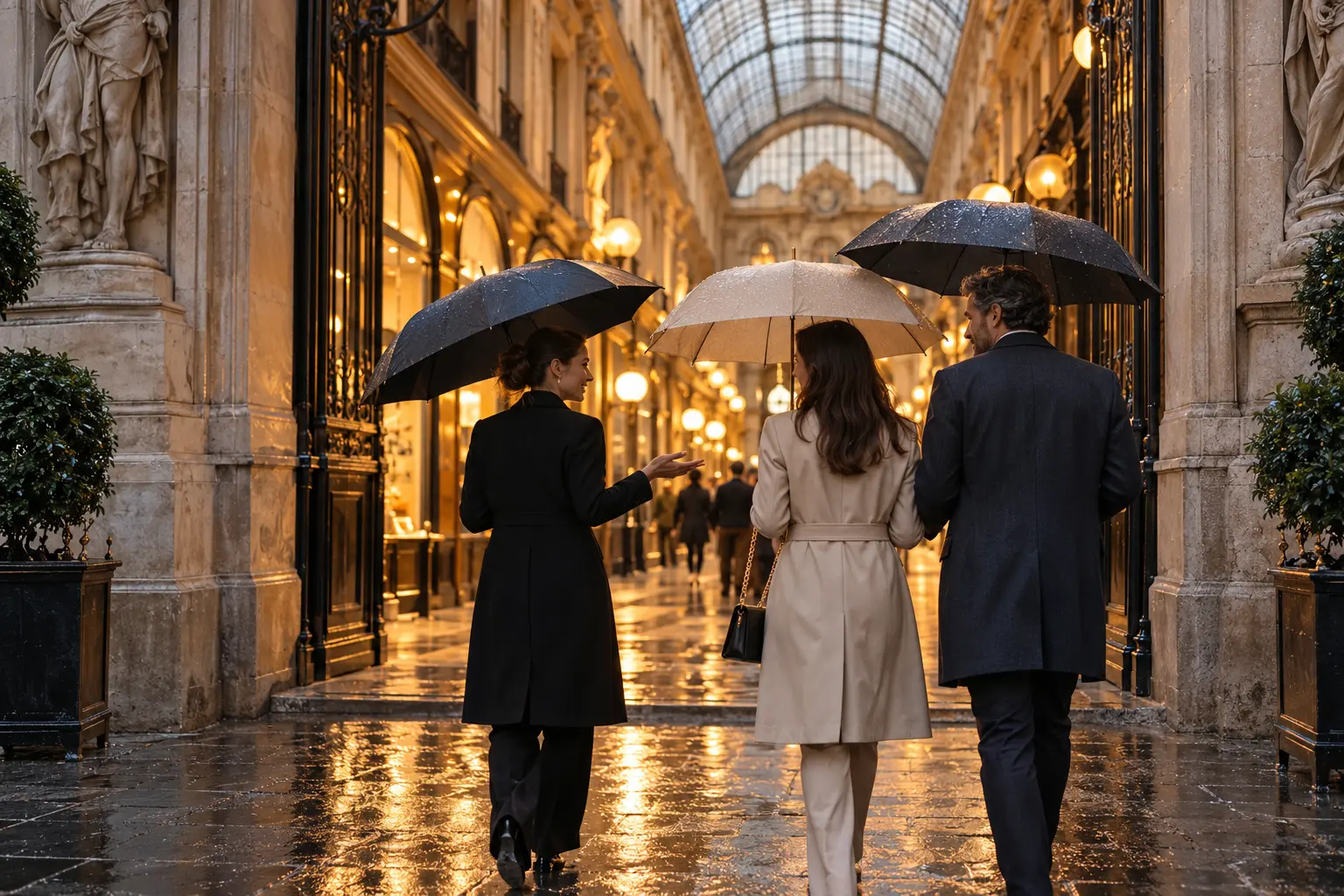
Rain changes logistics, not the cultural promise
A wet day in Paris becomes difficult when small transitions have been ignored. Waiting outside, finding a vehicle at the wrong moment or arriving at a crowded cloakroom can drain more energy than the visit itself. A premium itinerary therefore begins by removing friction rather than filling every available hour. It chooses a compact part of the city, builds in genuine shelter and allows enough margin for coats, umbrellas and slower entrances. Rain may add atmosphere, but an advisor should never rely on charm alone. The objective remains the same as on a clear day: guests should understand the thread connecting the day instead of feeling that a collection of emergency substitutions has been placed in front of them. Weather becomes one design variable among arrival time, cultural interests and mobility. When it has been considered in advance, it no longer controls the day; it simply helps the advisor rank decisions.
Build around one Paris neighborhood
Geography is the most reliable form of weather insurance. Areas around the Opéra, Palais-Royal or Saint-Germain-des-Prés can support several cultural sequences without exposing guests to long transfers. The idea is not to keep everyone indoors from breakfast to dinner. Short walks provide orientation and contrast, while museums, covered passages, private rooms and cafés offer places to listen, sit down and reset. A compact plan is also easier to adjust when conditions change. One outdoor element can be shortened without dismantling the whole itinerary, and the advisor retains control of pacing instead of negotiating a new route after every shower. This approach also reduces repeated vehicle changes, which can be more tiring than one short walk under an umbrella. A nearby alternative remains available without making guests feel that they have received a diminished program.
Give each interior a different purpose
Two major museums back to back may look efficient on paper and still produce a tiring day. Visual concentration, security procedures and dense interpretation accumulate, even when the collections are outstanding. A more considered sequence gives every interior a separate role. One setting supplies original works and material evidence; a conversation turns impressions into questions; lunch creates an interval in which guests can absorb what they have seen. This rhythm protects curiosity and prevents the day from becoming a series of ticket checks. It also creates a memorable structure that travelers can describe afterwards, which matters more to a sophisticated journey than the simple number of celebrated rooms entered. Contrast between collection, speech and hospitality sustains intellectual energy. Even highly knowledgeable guests benefit from a pause because the quality of a cultural day also depends on what it leaves them time to consider.
Read the covered passages as urban history
Paris passages are attractive because of their glass roofs, patterned floors and shopfronts, yet they are more than photogenic shelter. They belong to the history of commerce, circulation and the nineteenth-century desire to make urban movement comfortable and theatrical. A carefully chosen crossing can connect architecture with social history and present-day observation. Advisors should still account for narrow sections, busy hours and the fact that these remain working commercial spaces. Interpretation is strongest when it selects a few visible details rather than reciting every date. Rain then becomes an interpretive aid: guests understand the appeal of protected circulation without being told that the passage has survived unchanged since its creation. The route can address changing technology, commerce and urban behavior without becoming an outdoor lecture. Shelter then has a precise cultural reason, and the passage contributes meaning rather than merely keeping the party dry.
Use an Encounter as the narrative center
An Elyrea Encounter can supply the human continuity between objects, streets and monuments. The character does not replace a museum or claim to offer a neutral account of the past. A professional actor embodies a situated perspective, enabling guests to test ideas through attention and conversation. On a rainy day, that change of mode is especially valuable: the party moves from looking to questioning and connects the morning’s evidence with a lived point of view. Advisors should confirm the precise setting, duration, group conditions and included services separately. Explore Elyrea Encounters to identify the personality whose story gives the journey its most natural line without revealing the dramatic progression in advance. The chosen character should belong naturally to the district, theme and surrounding visits. The Encounter becomes stronger when guests arrive with a few images or questions that the conversation can complicate.
The practical details that protect attention
Weather makes operational details unusually visible. The distance from vehicle drop-off to entrance, cloakroom capacity, available seating, queue exposure and slippery surfaces should all be checked before the day begins. A margin of fifteen or twenty minutes may prevent one delayed entrance from affecting every later appointment. It is useful to know where wet umbrellas can be left and whether a group must assemble in a confined reception space. These considerations are not decorative luxury. They preserve the guests’ ability to listen and participate. When the mechanics have been anticipated, the welcome can focus on culture and pleasure instead of a sequence of apologies about conditions. A reliable umbrella, a vehicle positioned correctly and a well-briefed welcome often matter more than one additional address. Operational precision remains largely invisible to clients, yet it shapes their judgment of the entire day.
Adjust the rhythm to the people traveling
Rain does not have the same effect on every party. Teenagers, returning visitors, older travelers and a multigenerational family will have different tolerances for standing, walking and sustained interpretation. Some guests welcome a long indoor conversation; others need a short outdoor transition to retain energy between enclosed spaces. A valuable client brief records mobility, interests, language, previous time in Paris and appetite for last-minute change. That knowledge allows a prepared alternative to remain personal. It also prevents accessibility from being confused with simplified content: comfort and clear pacing should make depth possible, not replace it. A couple may also separate briefly for rest and reunite around the principal cultural moment. Flexibility feels elegant when it has been planned and explained without requiring anyone to defend their energy level.
A working method for travel advisors
Choose one main district, one narrative anchor and one alternative that has actually been checked. Organize the day around four functions: establish context, observe evidence, encounter a perspective and leave time to absorb it. Confirm current hours, tickets, entrances and group policies directly with every institution; geographic proximity never means that another venue is included in an Elyrea service. Tell clients how the day will feel and what clothing will help, but protect the moments of discovery. To shape a private sequence around specific interests, contact Elyrea with the date, language, party size and mobility considerations. A coherent rainy-day plan can then exist before the forecast becomes certain. Operational teams should receive the rain plan in detail, while guests experience it as a day deliberately chosen for them. That difference in language protects confidence and shows that premium planning is measured by adaptation.
FOR YOUR GUEST ITINERARIES
Planning a private cultural itinerary? Elyrea can help you weave this perspective into your guests’ journey.
Discuss your itinerary