
Familiar history becomes a physical place
Many American travelers encounter D-Day through education, films, museums or family accounts long before visiting France. Omaha is therefore often recognizable as a name and image before its geography is understood. Arrival changes the relationship: a date becomes sand, slopes and a distance toward higher ground. That physical encounter can be powerful without requiring a prescribed emotion. Guests may be surprised by the peaceful present landscape, and a thoughtful explanation helps connect it with what they know while distinguishing later representation from the varied historical event.
National significance does not mean one uniform motivation
An American visitor may come for military history, a relative's service, remembrance or an interest in a global turning point. These reasons can coexist, but they call for different emphases and should be discussed in advance. Assuming that nationality alone determines the desired tone makes personalization superficial. The advisor should ask what matters to the individual traveler. That answer can affect which places receive time, how much tactical explanation is useful and whether a personal memorial moment deserves priority within the day's design.
Family connections need real information, not an invented substitute
Where a guest has a relative associated with the war, available details about service, unit or place may guide the itinerary. Such evidence should take precedence over a generic narrative that happens to sound similar. The Encounter with Charles can provide a human-scale perspective on an American GI's immediate situation, but it does not stand in for that relative's actual biography. This distinction respects the family's interest and prevents emotional identification from being mistaken for documentation. A personal journey becomes stronger through careful connection with what is genuinely known.
The cemetery brings a different relationship with loss
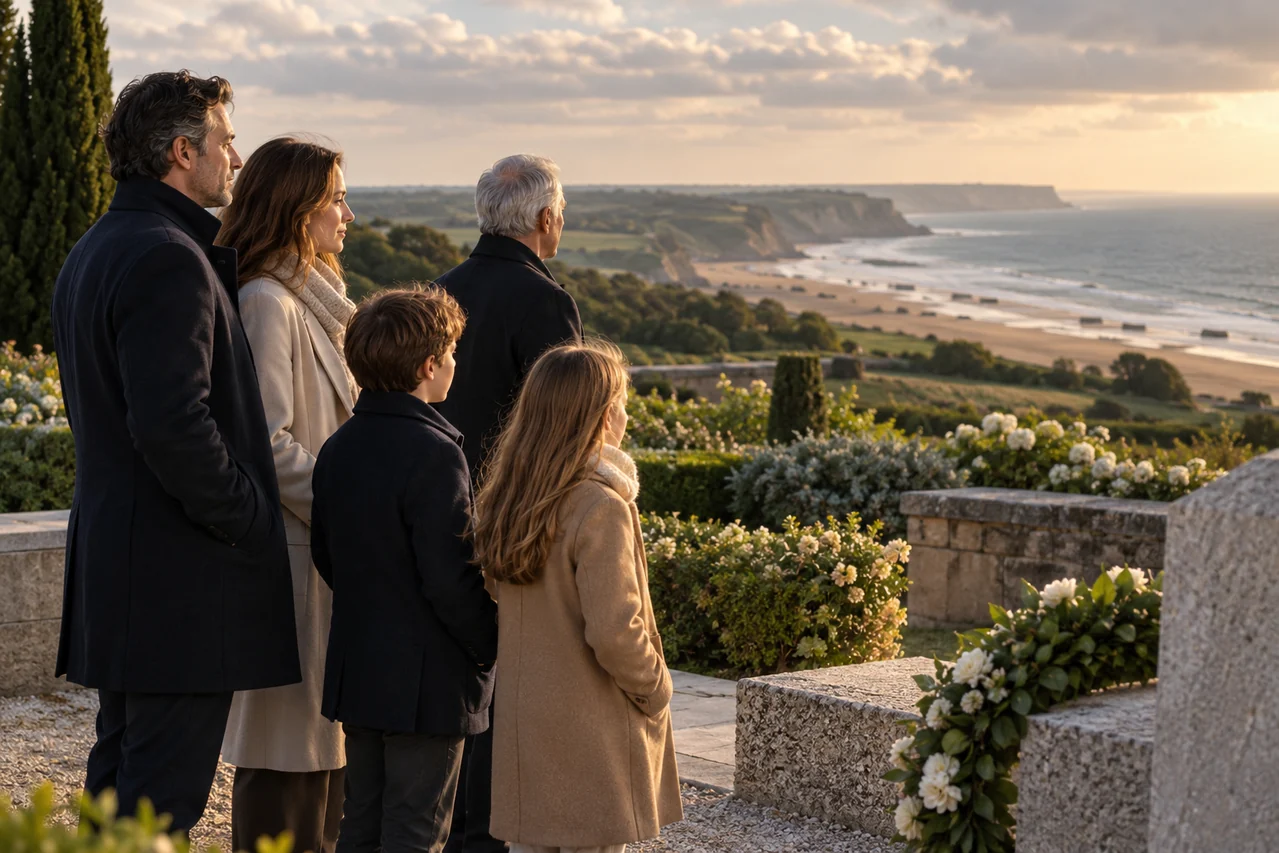
The Normandy American Cemetery above Omaha offers another scale of understanding beyond the beach's movement and terrain. Graves and particular names can make the human cost visible differently from statistics. For some guests, the visit will be deeply personal; for others, it supplies a broader moment of remembrance. Neither response should be forced. The itinerary needs room for reflection and a change of interpretive register. Military explanation may prepare the context, but constant commentary through every memorial moment can limit the guest's own encounter with the place.
Omaha also belongs to a Franco-American relationship
The Allied undertaking contributed to the liberation of occupied territory, and its remembrance remains visible in Normandy. An American visit can explore that relationship while keeping local experience in view. The French landscape was inhabited, and the campaign also involved civilian loss and destruction. Acknowledging those consequences does not diminish Allied sacrifice. It gives guests a fuller understanding of the place they have entered, linking a familiar national story with the experiences of people living where the fighting occurred and with the continuing life of the region.
Keep the wider Allied effort in perspective
Omaha's strong American identity should remain within a broader operation involving several nations, naval and airborne actions, logistics and prolonged fighting. Overlord and Neptune help establish that framework. Guests can honor a particular contribution without assuming that the whole campaign belonged to one beach or one nationality. The resulting history is more substantial than a simplified patriotic narrative. It recognizes uncertainty, adaptation and human cost alongside military achievement, while showing why the landing became a beginning for the Normandy campaign rather than its conclusion.
Charles adds proximity without replacing actual voices
The narrative GI in Elyrea's Encounter helps visitors consider what a person could see and understand amid a vast event. This embodied lens can make terrain and uncertainty more accessible than chronology alone. It remains different from recorded testimony and should leave space for actual accounts with their varied experiences. The individual scale of Omaha is useful precisely because it resists a single emotion attributed to everyone. A guest can engage with Charles's perspective while recognizing that the real participants had many stories, not one standardized experience.
Prepare the day around the guest, then allow room for response
Advisors can combine context, terrain, the Encounter and remembrance without trying to cover every Normandy landmark. Questions about family history and prior knowledge should guide the balance. Visiting Omaha respectfully includes allowing silence, appropriate pacing and an honest distinction between historical analysis and commemoration. The desired outcome is not a guaranteed emotional reaction. It is a visit in which guests understand where they are, why it matters to them and how their interests relate to the wider history of the place.
FOR YOUR GUEST ITINERARIES
Preparing Normandy for American guests? Contact Elyrea to discuss how the Encounter with Charles can complement their interests, family connections and wider D-Day itinerary.
Discuss your itinerary