
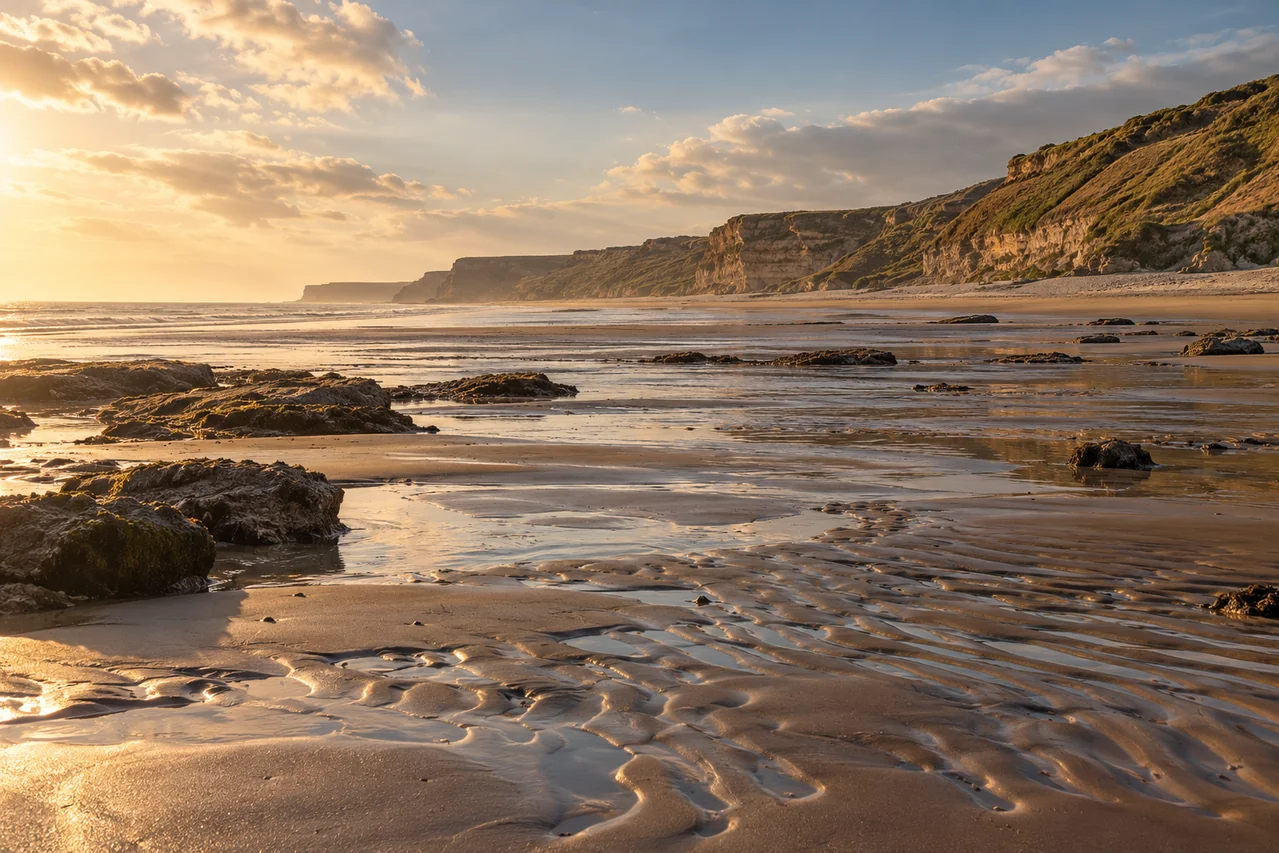
The ground gave defenders a significant advantage
Omaha's rising ground and limited routes inland created a demanding environment for forces arriving from the sea. Soldiers had to cross exposed space and then progress toward passages that defenders could cover. The topography is therefore fundamental, not incidental scenery around famous memorials. A traveler can appreciate the problem by looking inland from the sand and considering how movement is constrained. Reading Omaha's landscape gives that observation a structure, showing how beach width, slopes and exits work together in the explanation of the assault.
Defenses interacted with that geography
Obstacles, mines, fortified positions and weapons formed a system intended to delay, expose and channel attackers. The defenses were not simply a continuous wall that could be understood through one photograph of a bunker. Their effectiveness depended partly on where they stood and which approaches they could cover. This relationship helps explain why a site visit should attend to the spaces between structures as well as the structures themselves. Terrain and fortification reinforced one another, making the path off the beach a more complicated problem than reaching land alone.
Preliminary bombardment did not remove every threat
Air and naval bombardment were intended to weaken the positions the infantry would confront. Some defenses nevertheless remained operational when the assault forces arrived. That gap between expected effect and actual condition belongs to the explanation of the early difficulties. It should not be converted into one universal claim about every weapon or sector. The visitor's useful question is how surviving resistance changed the task facing men on the ground. The beach could not be approached simply as a location already made safe by the scale of Allied preparation.
Armored support was uneven under difficult conditions
The landing plans included tanks and other support, but the sea and launch conditions contributed to significant losses among some amphibious tanks. Infantry therefore did not everywhere receive the support anticipated in the plan. This is another example of several difficulties interacting: exposed movement became harder when expected assistance was missing or delayed. The explanation benefits from nuance about particular circumstances rather than the claim that all tanks had the same fate. It also reminds travelers that machinery and logistics were essential parts of a story often pictured only through infantry.
The first waves could lose their intended organization
Currents, smoke, obstacles and fire contributed to dispersal and landings away from assigned points. Men arriving under those conditions did not necessarily find themselves with the people, support or information expected. Command arrangements could be disrupted quickly. Later maps can make the assault look more intelligible than it felt to participants trying to identify where they were and what to do next. Understanding that difference restores uncertainty to the event, while avoiding the assumption that every local action followed a clear view of the whole battlefield.
Local initiative helped movement become possible
Small groups and officers on the ground adapted to conditions as they sought ways away from the most exposed areas. The success at Omaha cannot be described merely as the perfect execution of an original plan. It also involved responding when that plan met obstacles and incomplete information. The significance of initiative should not turn into a tale of effortless individual triumph; it belonged to dangerous collective circumstances and substantial loss. The Encounter with Charles can make that limited perspective tangible while wider interpretation connects individual action to the evolving assault.
Comparisons should not erase other landing experiences
Omaha is strongly associated with particularly severe American losses and difficulties. Recognizing that gravity does not require treating the other beaches as easy or unimportant. Each sector had its own combat, conditions and casualties. A useful account explains what distinguished Omaha while keeping it within the larger Allied effort. Overlord and Neptune's relationship provides that broader perspective. The visitor should leave able to identify interacting causes here, rather than merely repeat a ranking that obscures the complexity of events elsewhere.
Explore several viewpoints instead of one photo stop
For history-focused guests, time on the sand, attention to the high ground and explanation of exits can be more valuable than a rapid sequence of memorial photographs. The exact balance depends on mobility, weather and prior knowledge, and practical access should be planned appropriately. Charles adds a narrative human scale rather than a replacement for terrain analysis or documentary testimony. Advisors can use that combination to create a concentrated Omaha chapter, where travelers understand why movement was difficult and why reaching the beach did not finish the operation.
FOR YOUR GUEST ITINERARIES
Preparing Normandy for guests interested in military history? Elyrea can help connect the Encounter with Charles to a terrain-focused Omaha itinerary that suits their knowledge and interests.
Discuss your itinerary