
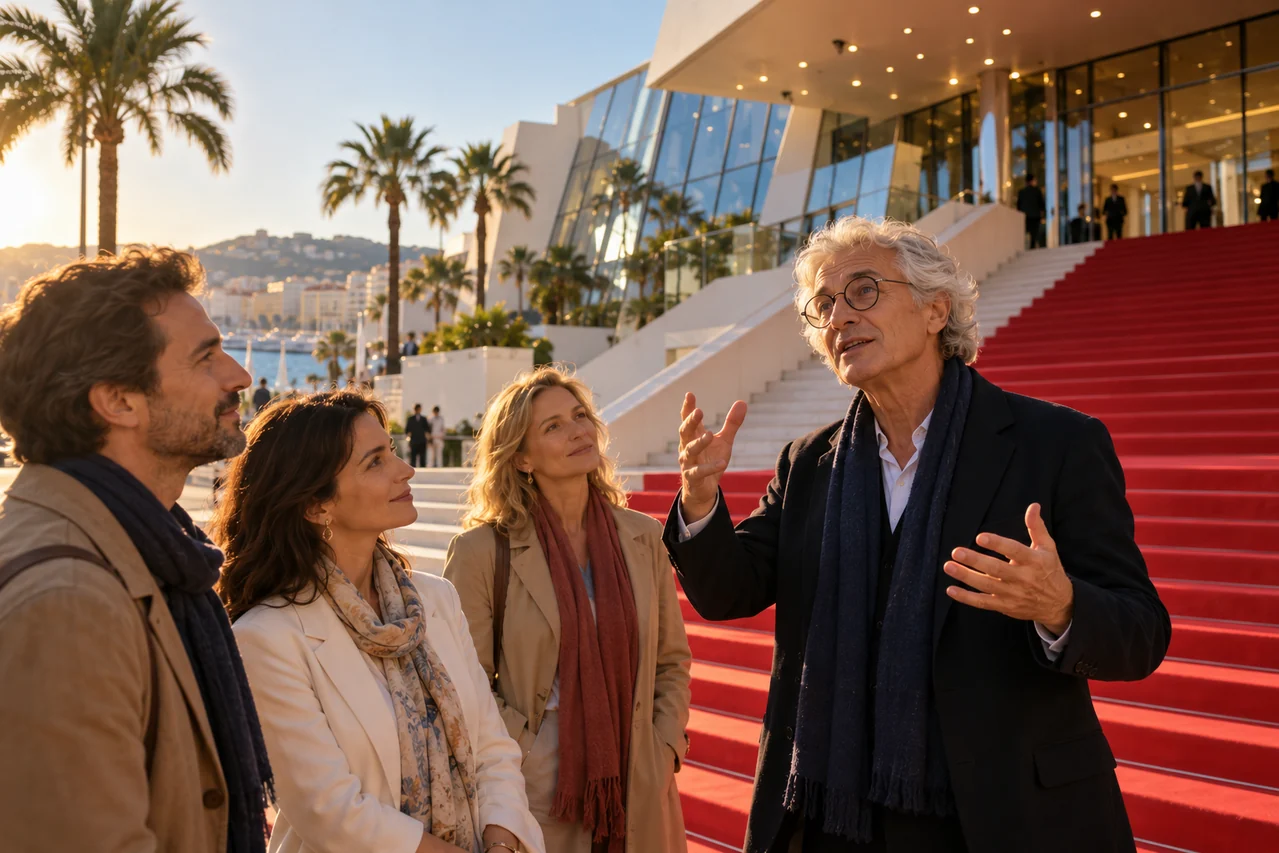
The building's function is central to its meaning
The current Palais des Festivals was inaugurated in 1983. Visitors sometimes expect a historical structure whose architecture alone explains the worldwide recognition of its location. Much of its importance, however, comes from the events concentrated there: screenings, ceremonies, professional activity and recurring public arrivals. The building is a setting for organized cultural life. This makes the Palais a useful example of how a modern place becomes iconic through use. Its significance is not limited to a façade, and cannot be understood fully without considering what happens around and within it.
Stairs can become famous through repeated actions
Physically, an ascent connects an arrival point with a destination. At Cannes, that movement has been repeated and represented until it is recognizable as a ceremony in its own right. The stairs therefore carry a meaning larger than their practical role. Visitors who stand nearby can consider the difference between ordinary movement and a ritual organized for a public audience. The important question is what turns a few moments into an event: clothing, timing, photography and expectation all contribute to the transformation.
Cameras make a local moment internationally visible
Press photographs and broadcasts extend the audience beyond those actually present. A guest's arrival can become an image consumed by people who never enter a screening room or even travel to Cannes. This is one reason the red carpet can appear to dominate the Festival in public memory. The media do not merely record a neutral scene; their framing and circulation help make the ceremony culturally recognizable. Understanding that relationship lets guests appreciate familiar images while noticing the work involved in selecting what becomes visible and memorable.
Fashion adds another language to the arrival
An outfit in this setting can communicate style, affiliation or a public position, and become a subject of discussion apart from the film associated with its wearer. Fashion houses and image-making professionals take part in that relationship between person and media. The cultural interest is not confined to expense or luxury. A traveler can ask why a particular form of dress fits the occasion and how the repeated presentation of clothing affects a brand or public figure. Paris fashion beyond shopping offers a complementary chapter on creation and cultural meaning.
The screening remains part of the ritual's purpose
A public image of the stairs can detach the arrival from what follows, yet the ceremony is connected with cinema and the formal event around it. Treating the red carpet purely as a parade of clothes obscures that relationship. Conversely, treating the public display as irrelevant misses how the Festival communicates with audiences beyond its films. A useful account keeps both in view. The ritual mediates between artistic work, invited participants and a watching public whose knowledge of Cannes may come chiefly through the images produced during arrivals.
Controversy can expose the ritual's changing rules
Gestures, appearances and expectations sometimes become disputed because the ceremony concentrates public attention. Such episodes can reveal questions about representation, authority or the acceptable forms of visibility. They should be examined with context rather than repeated as gossip. Cannes controversies and what they reveal provide a wider lens. The value of an anecdote lies in what it explains about the event and its period, not merely in the surprise it generates. That approach makes the red carpet a subject for cultural discussion rather than a list of sensational moments.
A quieter view reveals how the setting acquires fame
Outside the event period, the same location may look markedly less theatrical. This does not remove its significance; it reveals how much depends on temporary activity and public expectation. The visitor can separate permanent structure from ritual and understand how their relationship creates an icon. Actual circulation and access change with events, so an itinerary should be planned around real conditions rather than promises of walking a ceremonial route as though participation were automatic. Observing and understanding the setting can have value without implying official event access.
Connect the ritual with a narrative city experience
In Cinéma, Strass & Scandales, Elyrea's Quentin Tarantini is a fictional character offering a playful perspective on Cannes's cinema culture. He is distinct from Quentin Tarantino, and his role is not a real director's personal account. The Palais and promenade give that narrative a relevant environment. An Encounter can lead guests to read an image differently afterwards: the stairs become a relationship among cinema, fashion, cameras and audience, rather than simply a place where famous people briefly stand.
FOR YOUR GUEST ITINERARIES
Designing Cannes for guests interested in cinema, fashion or media? Elyrea can help integrate the fictional Quentin Tarantini Encounter into a day that reveals the meaning behind the famous image.
Discuss your itinerary