
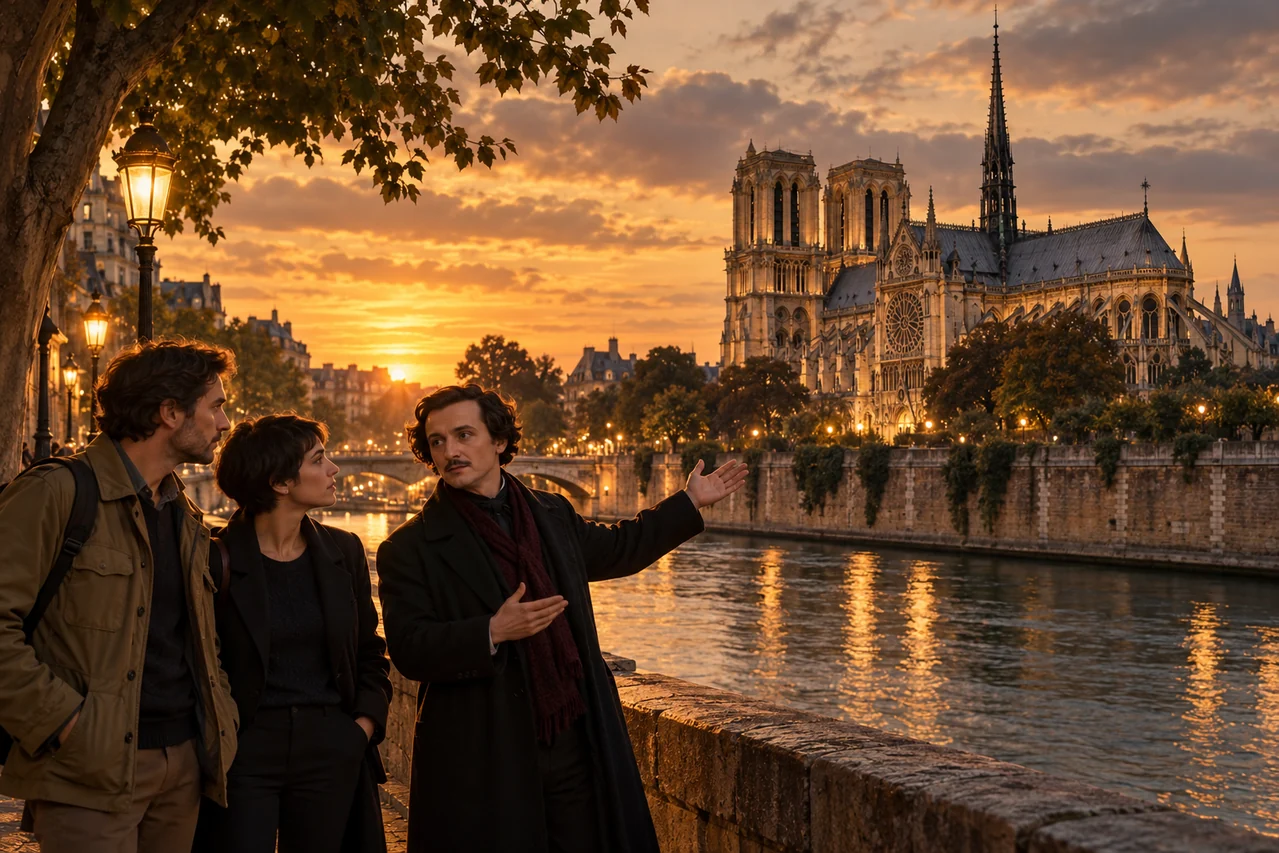
Look around the cathedral as well as at it
Notre-Dame naturally draws the eye upward toward its façade, towers and sculpture. The surrounding district invites a different kind of attention: what sort of city stood beside the building, and how did it change? The cathedral never existed apart from urban life. Beginning with that relationship helps visitors move beyond an isolated monument toward a neighborhood of inhabitants, institutions and routes, even where the earlier physical setting must now be reconstructed imaginatively.
The present island is not the old island intact
Major urban changes altered the density and appearance of the Île de la Cité, particularly during the nineteenth century. The open spaces and monumental approaches visitors see today cannot simply be treated as a preserved medieval street plan. This difference matters to legends attached to the district. A story may refer to an environment no longer visible, and the narrator should explain that absence rather than ask guests to accept the present scenery as unchanged evidence.
Rue Chanoinesse offers a smaller scale
Near the cathedral, Rue Chanoinesse provides a contrast with wider contemporary approaches. Its scale can encourage visitors to consider what a more closely built neighborhood might have felt like. The street should not be asked to represent the whole medieval island or certify every legend associated with the area. It works best as a surviving point of observation, from which a carefully framed account can consider proximity, enclosure and the changing uses of urban space.
Read the sculpture with its own history
Gargoyles and fantastical figures easily become shorthand for a dark medieval atmosphere. Yet the cathedral's visible sculpture has different histories, and some famous imaginative forms belong to nineteenth-century restoration rather than the original medieval building. Distinguishing those layers gives the visit more interest. It reveals how later generations helped construct the image of Gothic Paris that visitors inherit, an image influenced by artistic interpretation as well as surviving architectural fabric.
The river creates a different viewpoint
The Seine and its bridges allow guests to see the island as an urban setting shaped by water and connection. Approaching the Pont Neuf or the Vert-Galant changes the scale and perspective after the dense surroundings of the cathedral. Those places carry their own histories and associations, which should not be compressed into a single Notre-Dame legend. The journey works through the transitions between them, letting observation support rather than merely illustrate the narrative.
Poe's presence is a literary device
The Dark Legends of Paris brings an embodied Poe into this landscape because his work offers mystery, reasoning and unease. He is not being presented as a past resident whose addresses the visitor can verify. This distinction is fundamental to the premise of the Poe experience. The literary host encourages questions about evidence and uncertainty, making the changing island a useful setting for inquiry rather than an invented episode in an American author's life.
Choose between mystery and the novel
Esmeralda provides a different route into the surroundings through Victor Hugo's fictional characters and the Paris imagined in Notre-Dame de Paris. Poe focuses on legends and the mechanisms of mystery. Comparing Poe with Esmeralda helps an advisor distinguish these intentions. The two experiences can occupy the same broad geography while answering different guest interests; selecting one should depend on curiosity and literary preferences rather than treating them as equivalent visits to the cathedral.
Give the familiar monument a wider meaning
An advisor can pair this narrative with a separately arranged architectural or institutional visit when the guest wants both physical understanding and literary interpretation. Practical access belongs to that separate planning, not to an assumed promise of the Encounter. The aim is to help travelers look around Notre-Dame with more informed attention. What appears at first as a familiar landmark becomes part of a layered island, where surviving history and imaginative inheritance continually interact.
FOR YOUR GUEST ITINERARIES
For guests seeking another perspective on Notre-Dame, our team can help integrate a Poe Encounter with a careful exploration of the surrounding island.
Discuss your itinerary