
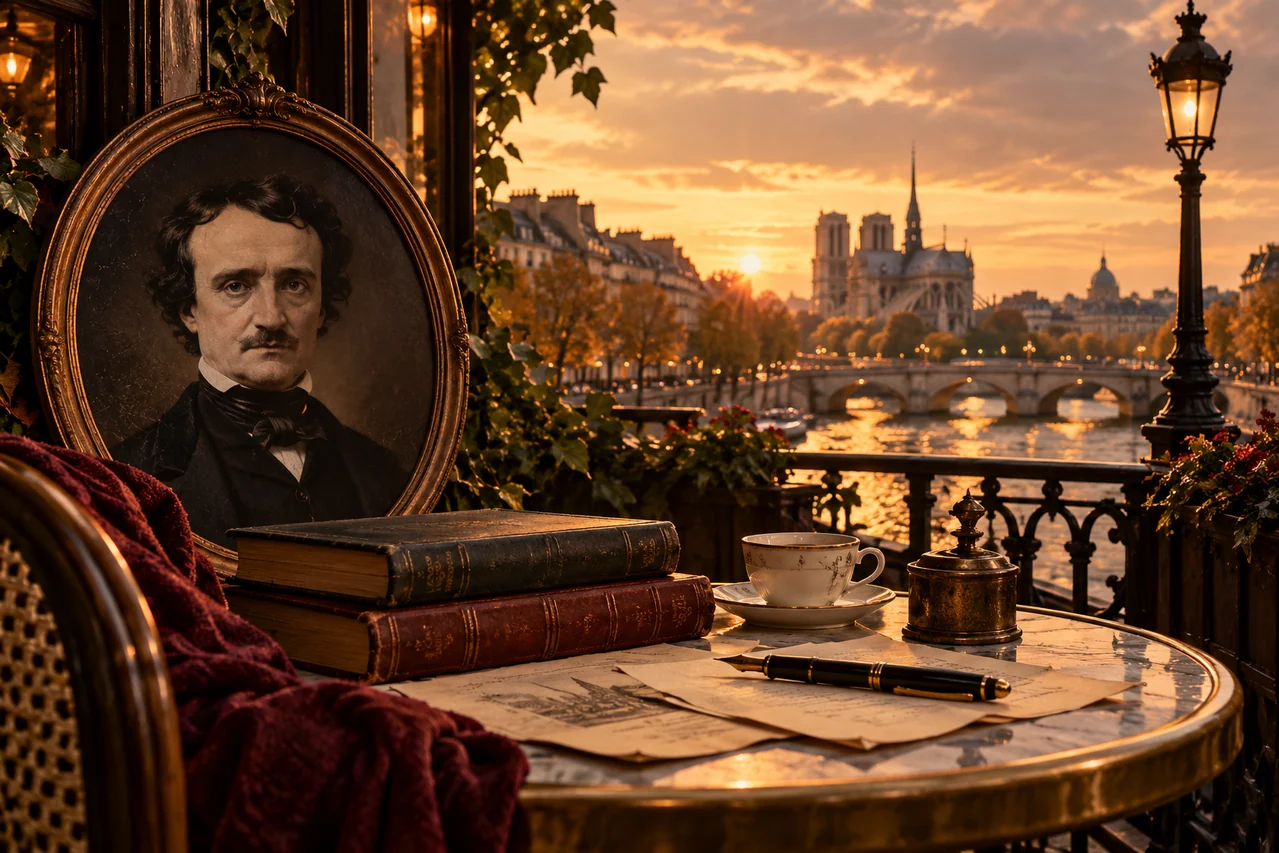
A relationship formed through books
Poe was an American writer whose reputation in France developed through the circulation and interpretation of his work. He did not establish a Parisian residence comparable to Hemingway's. That difference matters when designing a literary itinerary. A city's cultural connections do not depend only on the addresses where authors lived. Translations, readers and imagined settings can establish another kind of relationship, one that is particularly useful for understanding how literature travels between societies.
Look beyond the familiar horror image
Poe's work includes poetry, criticism, detective fiction and accounts that probe perception and reason. Treating him solely as a writer of fright narrows the reasons for his French reception. Mystery could be intellectual as well as disturbing, and the precision of a tale could matter as much as its unsettling subject. Travelers who begin with a familiar macabre image can discover a writer whose appeal to French readers involved form, imagination and the mechanics of interpretation.
Baudelaire became an influential advocate
Charles Baudelaire translated and presented Poe's writing, helping shape the way French readers encountered it. His work involved more than carrying sentences from one language to another. An advocate's introductions, choices and emphasis can create an authorial image as well as widen access to the texts. The literary relationship between Poe and Baudelaire explores that process more closely, including the distinction between the American writer and the image formed around him in France.
Translation creates a new reading context
A translated work enters the habits and expectations of another language. Readers may find qualities that are differently emphasized in the author's country of origin. This does not mean that the translation replaces the original or reveals its only correct meaning. It shows how reception becomes part of literary history. For a visitor from the United States, the French familiarity with Poe can therefore be a discovery: a known American author appears through another culture's reading of him.
Dupin gives Paris an imaginative role
Poe's detective C. Auguste Dupin lives within a fictional Paris that supports reasoning, observation and urban mystery. The setting does not amount to an eyewitness memoir, nor should a route seek an actual Rue Morgue as though the fictional address establishes a biographical location. Paris functions in the stories as an imagined city. The distinction between written setting and observed city creates a useful conversation about why an author might choose a place he did not personally inhabit.
French influence reaches beyond one translator
Poe's French literary afterlife is broader than a single association with Baudelaire. Later writers and readers continued to find resources in his handling of mystery and language. The subject is most useful when presented as a developing reception, rather than a claim that France alone understood or rescued him. Literature can gain new prominence and meanings across borders, and an itinerary can reveal those transformations without turning them into a competition between national cultures.
Compare literary Paris with biographical Paris
A traveler can explore Poe through French reception and then pursue an author whose daily Paris life is documented. Hemingway's arrival in the city offers that contrasting model. One route considers ideas and texts crossing the Atlantic; the other also involves homes, cafés and a lived expatriate environment. Holding the distinction clearly makes both experiences stronger. It shows that there are several legitimate ways for literature to become connected with a destination.
Give the Encounter an honest literary premise
The Dark Legends of Paris uses Poe as an embodied literary host for stories and questions around the city. His French cultural resonance helps explain the choice, while the theatrical premise explains his presence. Advisors can make that framing part of the introduction rather than leave guests to infer a false biography. The experience then becomes an invitation to consider how Paris can belong to an author's imagination and to readers' lives without having been his physical home.
FOR YOUR GUEST ITINERARIES
For American or international guests interested in literary exchange, our team can connect a Poe Encounter with a wider exploration of Paris through its writers and imagined worlds.
Discuss your itinerary