
Begin with a person and a question
A useful character-led itinerary starts with curiosity rather than a famous name alone. What did Eiffel want his tower to achieve? How did Chanel use Paris to establish a distinctive idea of style? Why did Marie-Antoinette's public image become so powerful? These questions provide a thread travelers can follow between otherwise separate places. They also leave room for disagreement and discovery: a recognizable figure opens the conversation, but the purpose is to understand the city more deeply. The practical first step is to turn recognition into an open question the whole party can understand. If one traveler is interested in design and another in social history, the question of how a public identity is made can hold both interests without treating them as identical. The answer should not be supplied entirely at the beginning. Establish the setting and circumstances, then let successive places develop the inquiry. That structure gives a character a useful role within the journey: the person organizes attention, while the city and its wider history continually complicate the initial impression. It also lets an advisor explain clearly what this particular experience contributes beyond another familiar monument visit. A clear opening question also helps companions find their own way into the subject, even when only one member of the party initially selected the famous figure.
Let the place contribute evidence
The setting should do more than provide a picturesque background. Montmartre helps explain the practical environment in which artists worked; the Île de la Cité connects Hugo's imagined medieval city with the cathedral that inspired it. Place Vendôme contributes to a reading of Chanel's Paris through its architecture and associations. When place and subject belong together, travelers can examine something tangible while considering an idea. A character placed anywhere in Paris would lose much of that connection. A useful test is whether the story would change if it were moved to another neighborhood. If the answer is no, the relationship with place is probably too weak. Distances between a workplace and a hotel, the functions of a public square or the presence of an artistic supplier can all make an interpretation more specific. Explain those relationships without claiming that every facade or interior has remained unchanged. The present city supplies traces and new uses as well as surviving forms. Travelers learn to look at the actual surroundings rather than imagine that an attractive setting automatically authenticates every anecdote associated with the character.
Distinguish historical lives from literary worlds
Marie-Antoinette, Hemingway and Joséphine Baker were real people whose lives can be investigated through historical evidence. Esmeralda is a fictional character in Victor Hugo's Notre-Dame de Paris. Both kinds of figure can illuminate a destination, but they do so differently. A literary character helps us explore an author's imagination and its relationship with the city; a historical figure requires attention to biography, context and the limits of evidence. Making that distinction clear strengthens the experience rather than diminishing its atmosphere. The same care applies to the status of what a traveler hears. A novel can reveal an author's concerns and generate a powerful emotional relationship with a monument without documenting every event depicted. A performed historical figure may use invented dialogue to communicate a context, but the invention should not be presented as a recovered quotation. These distinctions are accessible to non-specialists when explained through examples rather than terminology alone. They allow a family or mixed-interest group to enjoy an immediate narrative while keeping a clear idea of whether a scene concerns biography, literary imagination, folklore or the theatrical language of the Encounter.
Look beyond the familiar image
The most recognizable detail is often the least useful place to stop. Chanel's style, Marie-Antoinette's clothes or Napoleon's military reputation can begin a discussion, but each leaves substantial questions unanswered. A mature cultural journey considers the institutions around these people, the constraints they faced and the consequences of their choices. Fame becomes a doorway into a period instead of the destination itself. This approach is particularly rewarding for returning visitors who already know the major monuments. A deeper interpretation also examines how an image became familiar. Which features have later audiences chosen to remember, and which are less visible? A fashion founder's silhouette can obscure workshops and difficult political choices; a military leader's victories can overshadow civilian consequences or the institutions that sustained power. The purpose is not to remove every pleasure from recognition, but to provide enough context for recognition to become understanding. Guests who know the icon well can then encounter something genuinely new without being promised a hidden address. What changes is their relationship with a familiar image and the city that helped sustain it.
Give supporting figures their place
A celebrated person never creates a city alone. Publishers, craftspeople, merchants, assistants and audiences help explain how cultural achievements become possible. Père Tanguy's role as a color merchant and supporter of artists is a useful reminder that art history includes relationships and material needs. A journey organized around famous figures should therefore widen its focus at appropriate moments. The result is a more convincing account of Paris, with space for people whose names travelers may not have known before. Supporting figures also provide useful contrasts within a day. After discussing a celebrated painter, a supplier's view introduces the cost of materials, the uncertainty of sales and the need for practical arrangements. After considering court display, attention to people doing the work behind it reveals another experience of the same institution. These are not digressions if they answer the itinerary's central question. They broaden it. An advisor can use a few carefully selected examples instead of a long catalogue of unfamiliar names, allowing guests to understand that achievement and authority rely on systems of labor and support beyond the individual who dominates later memory.
Use conversation without turning interpretation into evidence
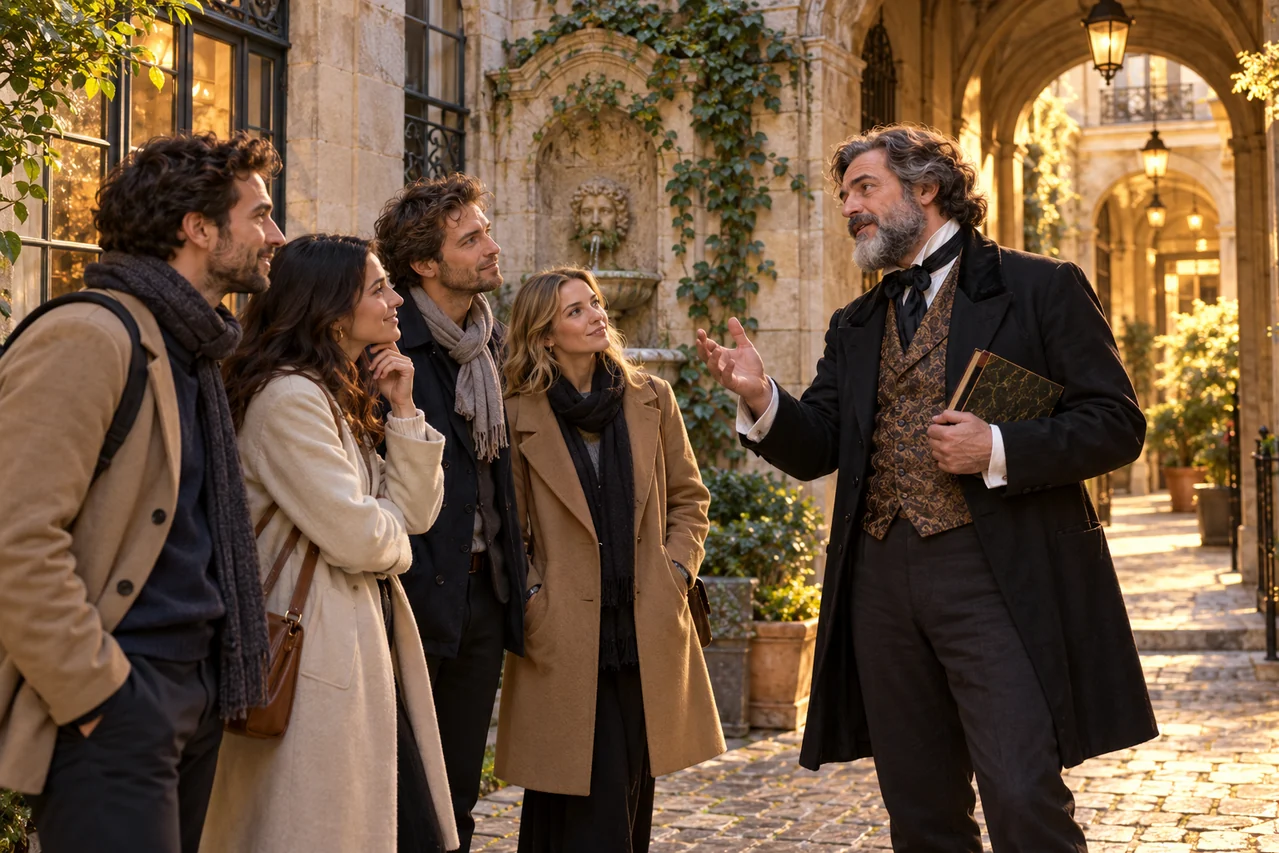
An Elyrea Encounter brings a historical or emblematic character into a setting connected with the story. Its value lies partly in allowing travelers to ask questions and respond, rather than simply receive information. The performance remains an interpretation: a spoken scene is not an archival testimony. Good cultural mediation keeps documented facts, debated interpretations and theatrical invention distinct. That clarity allows the encounter to feel immediate while preserving the distance necessary to think critically about the past. Interaction works best when it helps visitors examine the subject, not when it is measured by how often everybody speaks. Some guests may formulate a question directly; others may connect an answer with something they noticed on the walk. The performer can offer several points of entry while preserving the seriousness of sensitive material. An unresolved historical issue should remain unresolved rather than being settled by the character's confident voice. The experiential immediacy gives the audience a reason to care; accurate framing supplies the limits within which that engagement is meaningful. Together they produce a conversation that can continue after the performance without leaving the traveler with invented certainties.
Choose a character to suit the traveler
An advisor can ask which person a guest would most like to question, and why. The answer may reveal a stronger itinerary direction than a list of preferred sights. A reader might choose Hemingway's Paris, while a traveler interested in design may prefer the Chanel story around Paris. A family could find a shared starting point in Eiffel or Esmeralda. The selection should follow an actual interest, with the pace and level of explanation adjusted to the whole group. Ask what attracts the guest to the figure before making the recommendation. Someone choosing Hemingway may want literary technique, expatriate life or a personal connection with a book; those are not interchangeable requests. A guest choosing Chanel may be interested in entrepreneurship rather than shopping. The surrounding itinerary should respond to that distinction through collections, neighborhoods or free time suited to the interest. Practical fit matters alongside intellectual fit: comfort with walking, preferred language and willingness to participate help determine whether the selected format will be enjoyable. Nationality or budget can suggest possibilities, but neither should replace this conversation about what the traveler hopes to understand.
Build chapters instead of a parade of celebrities
Several character encounters do not automatically form a coherent trip. Choose a relationship between them: artistic creation, women's public reputations or the changing meaning of power. Leave space for museums, independent observation and meals so that the stories can settle. For a broader structure, planning a thematic journey through France helps connect these chapters without crowding the schedule. The most successful character-led Paris itinerary gives travelers a way to read the city that they can continue using after the experience ends. A theme can also help decide what to omit. If an additional encounter repeats the same kind of story without changing the question, a museum visit or independent pause may contribute more. If it introduces a distinct period or medium, explain the transition so guests recognize progression rather than another appointment. Preserve time for guests to make their own connections instead of interpreting every minute. The most coherent trip allows several forms of engagement: looking at evidence, listening to a narrative, questioning it and reflecting privately. Character-led travel then becomes a way of reading Paris that extends beyond the scheduled Encounter, rather than a series of celebrity performances with no shared direction.
FOR YOUR GUEST ITINERARIES
Designing Paris for guests with a particular cultural passion? Our team can help you choose an Elyrea Encounter that connects the right character with the right place.
Discuss your itinerary