
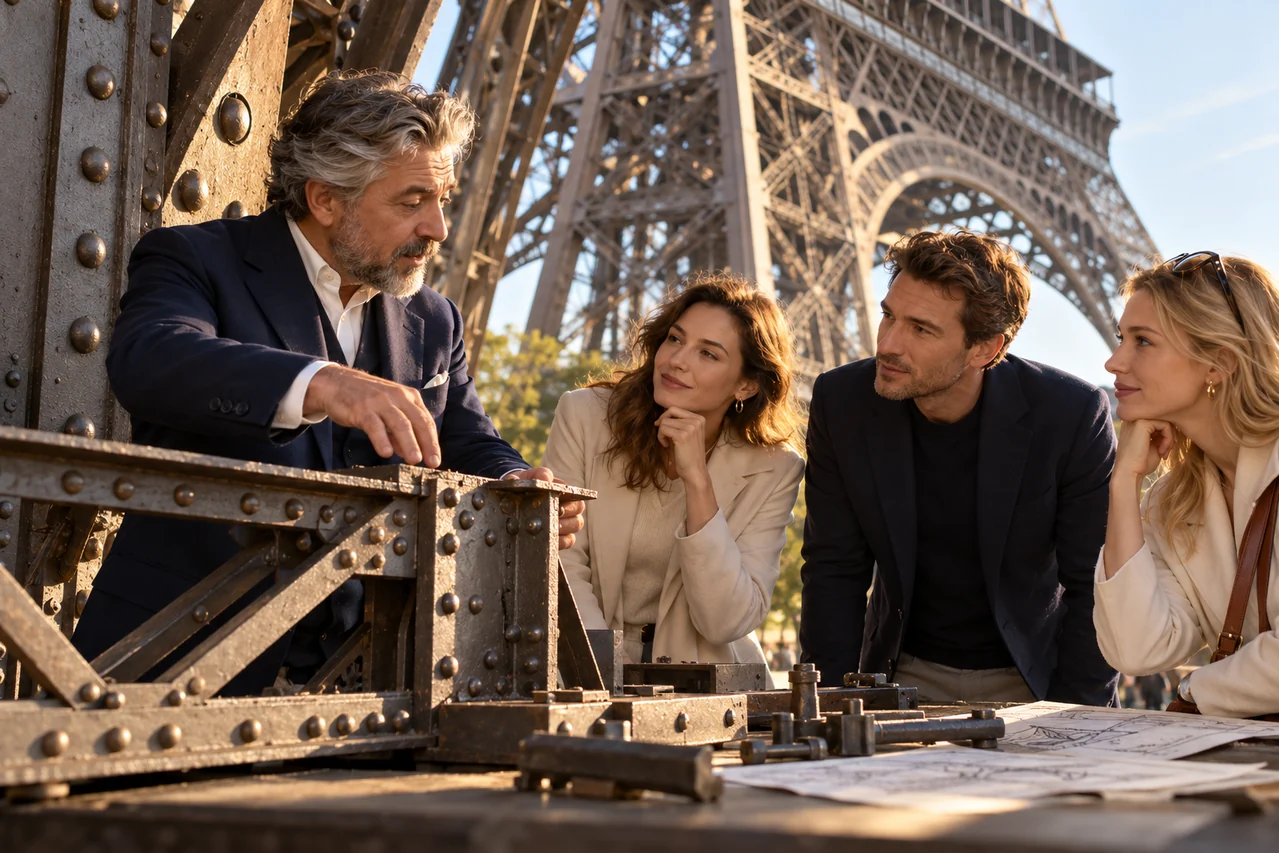
The deadline gave the project its rhythm
Construction began in 1887, and the tower had to be ready for the 1889 World's Fair. The short timetable did not remove the need for careful design; it increased the value of preparation and coordination. Thinking of the site as an isolated burst of activity misses much of the explanation. Drawings, component planning and workshop production were part of the achievement. The visible rise over Paris depended on work that visitors could not see from the Champ-de-Mars.
Preparation happened before assembly
Many metal elements were prepared in workshops before arriving at the construction site. Precision made it possible to assemble numerous separate pieces into one coherent geometry. This industrial organization distinguished the project from an image of builders improvising as they climbed. The tower was large, but its success depended on attention to small relationships: where parts met, how they were aligned and how each stage supported the next. A visitor can begin to understand that logic simply by studying its repeated connections.
The foundations belonged to the achievement
The celebrated metal silhouette rests on work below ground. Each of the four supports required foundations suited to its position, with conditions near the Seine demanding particular attention. These less visible stages mattered as much as the spectacular ascent. An engineering itinerary should therefore avoid treating construction as beginning when the first beams appeared. Buildings distribute forces into the earth; understanding what lies beneath the familiar shape makes the entire structure easier to read as a connected system.
Four inclined supports had to meet
The tower's lower legs rise inward rather than straight upward. Their relationship required careful control and adjustment as construction progressed toward the first level. That geometry makes an excellent observation exercise from the ground: the visitor can trace separate supports moving toward a shared structure. The form that now looks inevitable was once a practical assembly problem. Calculations had to remain meaningful under site conditions, and the sequence of work mattered to achieving the final alignment.
Rivets turned parts into a structure
Thousands of metal elements and millions of rivets joined the tower together. Their number can impress, but their purpose is more useful than a statistic alone. Connections allow separate components to behave as parts of a larger construction. For families, following how one beam joins another offers a clear entry into an otherwise overwhelming monument. For engineers and architects, the same view invites discussion of repetition, tolerances and the relationship between fabricated pieces and overall structural behavior.
Skilled labor deserves a place in the story
Engineers and organizers depended on workers who fabricated components and assembled them at increasing heights. Their contribution reveals the skill and coordination required for fabrication and assembly at increasing heights. The tower is evidence of coordinated expertise across different occupations. Who designed the landmark and who built it are connected questions, but they are not interchangeable. Giving both attention produces a more complete account than attributing every stage to Gustave Eiffel alone.
The wind helps explain the shape
The tower's design responds to forces, including the action of wind. Its outline is therefore more than an attractive silhouette chosen for a postcard. Observing its widening base and narrowing upper structure encourages visitors to ask why different parts take different forms. The building can become a practical introduction to engineering, with the monument supplying the evidence. That approach suits teenagers as well as adults because it begins with something visible rather than requiring a technical lecture before any discovery occurs.
Reading the finished tower differently
After learning about preparation and assembly, travelers often notice details they previously overlooked. The lattice becomes a record of decisions, and the construction timetable becomes an organizational story instead of an isolated marvel. This perspective can complement Eiffel's wider career or an Encounter centered on innovation. For a travel advisor, it offers a clear way to adapt an iconic attraction to guests interested in how things work, while leaving ascent arrangements and other practical access questions to separate itinerary planning.
FOR YOUR GUEST ITINERARIES
Planning Paris for a family or guests interested in major engineering projects? Ask Elyrea how to connect Eiffel by Eiffel with the tower’s construction story.
Discuss your itinerary