
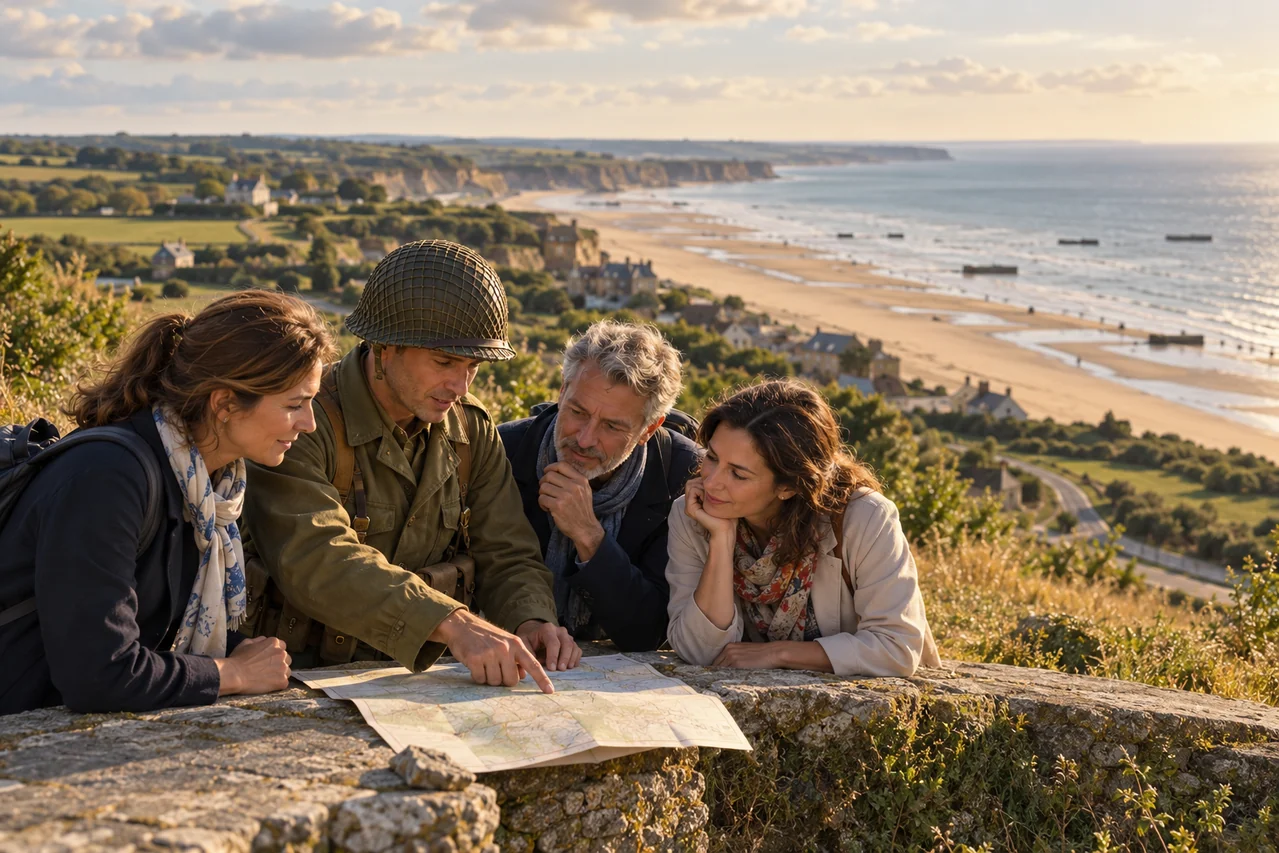
Establish what the guest hopes to understand
A military specialist, a family following an ancestor and first-time visitors need different choices of places and emphasis. Begin by asking about existing knowledge, meaningful connections and preferred pace. An ancestral connection may determine priorities that no standard route can anticipate, while a general visitor may need a clearer introductory framework. That information should guide the program before attractions are assembled. Personalization is therefore a matter of editorial purpose as well as transport and comfort: the day must answer a question that matters to the people taking it.
Give the operation a clear but concise framework
Before the beach, explain the relationship between D-Day, Neptune and Overlord, and Omaha's place among the five landing sectors. These connections make the visit understandable without consuming the morning in a complete campaign lecture. Overlord and Neptune's distinction is particularly useful for avoiding the impression that the whole operation ended at the sand. Guests should arrive with enough context to ask informed questions, while still having the attention and time needed for observations on the ground to deepen what they have learned.
Allow Omaha to be read from more than one viewpoint
The relationship between water, exposed beach, high ground and exits provides the site's tactical logic. A brief photo stop cannot usually establish those connections. Select viewpoints according to conditions, access and the group's ability to walk, rather than treating every possible sector as mandatory. The important outcome is that guests can explain why movement was difficult and where it was intended to lead. Reading the landscape at Omaha offers a focused approach in which the terrain between landmarks can matter as much as the landmarks themselves.
Place the Encounter where it adds a human scale
Charles can link geographical explanation with an American GI's narrative perspective. His role is to make immediate questions of movement, information and vulnerability intelligible, not to invent a documentary life or replace real testimony. The Encounter belongs where guests already have sufficient context to connect the individual viewpoint with the wider landing. It should also leave room for discussion afterwards. If every minute is allocated to another site, the narrative may become one more concentrated activity rather than the center of a coherent historical understanding.
Treat the cemetery as a different chapter
The Normandy American Cemetery should not be approached only as another tactical viewpoint or a convenient photographic stop. It gives the human cost a commemorative form and may hold particular meaning for individual guests. The day needs a shift in pace and tone when moving there. Some historical explanation can prepare the setting, but silence and personal attention also matter. Advisors should make space for the group's actual response rather than prescribe an emotion or keep a stream of commentary going because the schedule appears to require it.
Choose additional interpretation with a purpose
A museum can contribute objects, maps and context that the outdoor sites alone do not provide. The choice should follow the guest's interests and complement, rather than duplicate, other explanations. Several museum stops can consume the time needed to experience the terrain properly. The same restraint applies to covering all five beaches in one day. A longer journey can explore additional sectors with depth; a single day benefits from acknowledging its limits and giving selected places enough time to become intelligible rather than collecting names on a route.
Include a real pause and a contemporary region
A comfortable lunch provides recovery from a day that may be physically and emotionally demanding. It also reminds guests that Normandy is a living place, not only a landscape mentally fixed in 1944. The pause does not need to be filled with more wartime anecdotes. Families and guests combining remembrance with a broader French journey may particularly value that change of rhythm. Practical arrangements and access should be confirmed as part of the program, while enough flexibility remains for the group to absorb what has already been encountered.
End by widening the perspective beyond 6 June
The landing opened a difficult campaign rather than completing it. A final synthesis can connect the day's terrain and human perspective with that continuation without delivering another long lecture. Guests might consider how planning, adaptation and remembrance relate to the places they visited. The Encounter with Charles is one contribution within this architecture, alongside context and evidence. A successful premium itinerary is not measured by eight completed stops instead of four. It is measured by the understanding guests retain and the room they had to make the visit personally meaningful.
FOR YOUR GUEST ITINERARIES
Creating a Normandy day for your guests? Contact Elyrea to discuss how the Encounter with Charles can connect Omaha's landscape with their interests and the wider itinerary.
Discuss your itinerary