
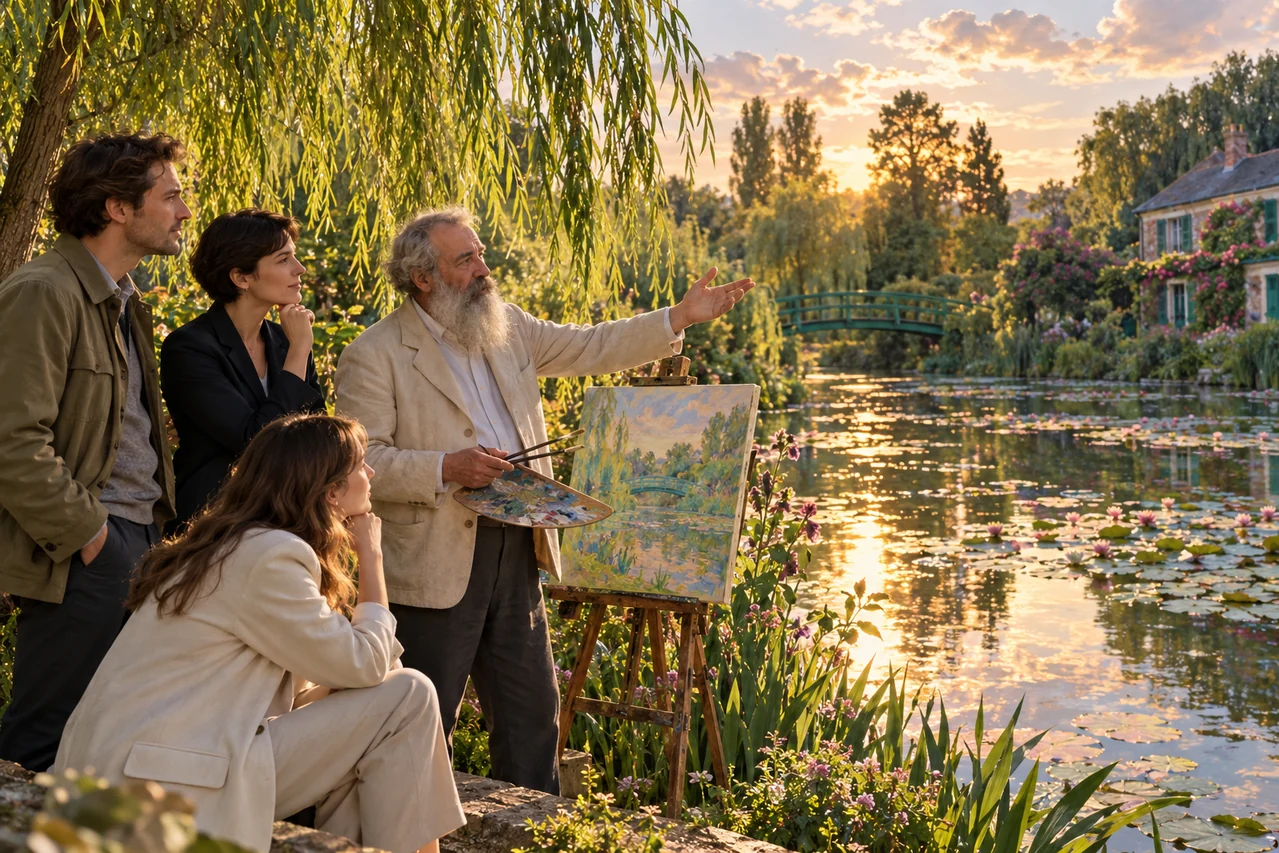
Light changes the subject without changing its identity
A building, field or pond can remain in place while its appearance changes radically through the day. Monet's interest lies in those conditions of perception. He does not treat light as another object standing beside the motif. He paints how illumination affects what the viewer sees: relationships of color, the strength of contours and the apparent depth of a surface. This helps explain why returning to a subject could create another artistic problem rather than another repetition of the same answer.
Earlier painters also understood light
Monet did not invent attention to illumination, and the history of painting before Impressionism should not be described as indifferent to it. His importance lies in the particular emphasis and practices through which changing perception became central to his work. Keeping that distinction avoids a simplistic before-and-after story. Visitors can recognize innovation as a development within artistic history, rather than assume that one painter suddenly discovered a visible phenomenon that others had entirely overlooked.
Outdoor practice brought changing conditions closer
Working before a motif made variation in weather and illumination an immediate practical concern. The view could shift while the painter worked. This did not eliminate studio decisions or make a painting an automatic record of a moment. It created an exchange between observation, memory and technique. Guests can understand that pressure at Giverny by watching the surface of water or a planted border change, then considering what would be required to transform the experience into an image.
Color depends on relationships
A shadow need not be represented as simply black, and a surface does not have one unchanging color independent of its surroundings. Monet's paintings make those relationships visible through contrasts and touches of paint. A visit can approach the idea through ordinary observation: the same flower looks different against another background or under another light. The explanation becomes accessible without a technical lecture, while experienced viewers can pursue more precise questions about how painted relationships create a convincing visual sensation.
Visible brushwork changed expectations
Brushwork that remained apparent could challenge expectations of a smoothly finished image. The viewer sees paint as well as subject, and the image asks to be understood through that relationship. This belongs to the broader history of Impressionism, in which Monet worked alongside other artists rather than transforming painting entirely alone. A cultural account should preserve that collective context while giving his own sustained investigations their due. Innovation emerges through particular works and exchanges, not only through a celebrated individual name.
Series make variation a sustained inquiry
Repeated views of subjects such as the Rouen cathedral allow the motif to remain familiar while light changes the account of it. The sequence gives viewers a way to compare perceptions that would otherwise disappear into the passing day. Monet's repeated Water Lilies takes this method into the garden he developed at Giverny. The repetition is therefore a structure for inquiry: it brings time and changing conditions into focus without requiring the artist to search continually for a new subject.
Painting is a transformation, not a measurement
Monet's images do not simply show exactly what any visitor would have seen in the same place. Selection, framing, color and material decisions transform observation. Photography offers another way of making an image, not proof that painting became unnecessary. For photographers and artists visiting Giverny, this distinction can be particularly useful. The question is what a medium and a maker can do with a subject, rather than which form produces a single definitive copy of the visible world.
Use Giverny as a place to practice attention
Inside Claude Monet’s Giverny can turn familiar garden views into questions about reflection, color and change. The embodied painter provides a theatrical voice for an inquiry that guests can begin through their own observation. The gardens as an artistic environment gives the broader setting. Advisors can allow enough time for looking, so that the lesson is experienced rather than only explained. Guests leave with a more attentive relationship to Monet's paintings and perhaps to the landscapes they encounter afterward.
FOR YOUR GUEST ITINERARIES
For guests interested in painting, photography or the act of looking, Elyrea can help make Monet's questions about light the focus of their Giverny Encounter.
Discuss your itinerary