
Place the battle inside the campaign
Austerlitz on December 2, 1805 belonged to the War of the Third Coalition, not an isolated contest arranged to display Napoleon's talent. The preceding campaign and French advance had created the circumstances for confrontation with Austrian and Russian forces. Restoring that sequence helps explain why the battle mattered politically as well as militarily. It also discourages a simplified story centered only on a few rulers, as though armies, alliances and earlier movements were irrelevant to the decisive day.
Three emperors made a memorable title
The association of Napoleon, the Austrian emperor Francis II and Tsar Alexander I helped give the battle its celebrated identity as the Battle of the Three Emperors. The phrase is effective, but it compresses a much larger undertaking into three names. Operational decisions involved commanders, formations and thousands of people. Travelers can enjoy the recognizable historical label while asking what it conceals. The symbolism belongs to the story of Austerlitz, but it should not replace the mechanisms through which the fighting unfolded.
Perceived weakness influenced decisions
Napoleon encouraged an impression that parts of his position could be attacked advantageously. Allied decisions then helped create opportunities within their own deployment. This relationship between perception and action is important, yet it should not be presented as complete control over an opponent's mind. The opposing commanders made choices in an uncertain situation. A careful account preserves that uncertainty, allowing Napoleon's actions to be evaluated without suggesting he had scripted every enemy movement before the battle began.
The Pratzen Heights mattered through position
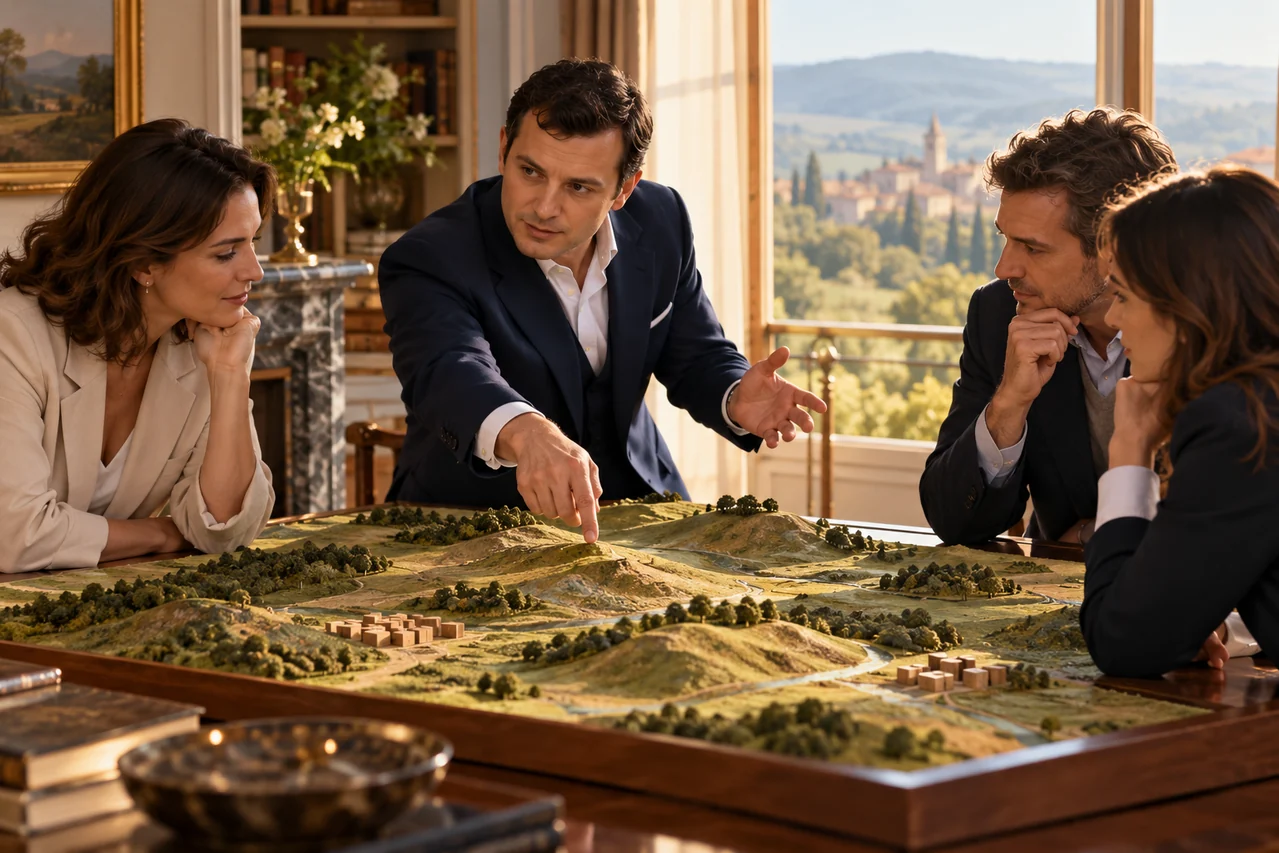
The plateau became central because of what its control could do to the allied arrangement. When French forces attacked there, they exploited a vulnerability related to allied movements elsewhere. Terrain mattered through its relationship to forces and objectives, rather than as a magical location whose possession automatically delivered victory. This is a useful lesson for visitors reading a battle: the meaning of a place depends on the situation around it, and a map becomes informative when linked to actions and timing.
Execution required more than a plan
French commanders and soldiers had to carry out movements and respond to conditions on the ground. Their work is essential to explaining why the plan achieved results. An intention at the top does not eliminate the need for coordination at every level. The organization behind Napoleon's reputation provides a broader context for this point. Guests interested in decision-making can examine how a strategic idea traveled through a military system, while remembering that its execution involved danger and physical effort for real people.
Weather became part of the legend
The mist and the celebrated sun of Austerlitz entered the memory of the battle as powerful images. Weather belonged to the conditions of fighting, but its later symbolic use is a separate subject. The victory's narrative combined memorable terrain, imperial participants and a dramatic outcome, making it especially suitable for propaganda and commemoration. Distinguishing those layers allows travelers to understand why the battle became famous without treating every familiar image as a complete explanation of what actually happened.
A victory still involved human suffering
Analyzing maneuver can create the misleading impression of a bloodless intellectual game. Austerlitz was a battle with dead and wounded, and those consequences should remain visible even when the cultural focus is strategy. This does not prevent discussion of effective decisions; it gives that discussion an appropriate scale of responsibility. A sophisticated private experience can hold technical analysis and human cost together, avoiding a theatrical celebration that would erase what battlefield success meant for the people exposed to it.
Use the case to invite reasoning
An Encounter can introduce positions, incomplete information and possible choices before revealing the outcome. Guests then participate in interpreting a situation rather than memorize a victory. Comparison with Napoleon's failure in Russia prevents one successful case from becoming a universal recipe. Elyrea's character-led approach can give the questions a human voice while retaining the distinction between dramaturgy and historical evidence. For advisors, Austerlitz supplies a focused subject for military-history guests without requiring the Paris visit to become an exhaustive survey of every campaign.
FOR YOUR GUEST ITINERARIES
For guests interested in military decisions, ask Elyrea how Austerlitz can provide a focused historical question within a Napoleon Encounter in Paris.
Discuss your itinerary